
How to Verify Inverter Conversion Efficiency Above 99%
Key Takeaways
- How grid access delays are reshaping renewable project timelines in Latin AmericaDr. Elena Volt
- What drives energy storage systems price per kWh for commercial projects?Dr. Julian Volt
- What manufacturers should compare in emissions tracking softwareLina Cloud
- Why high-net-worth buyers are reshaping demand for automotive technologyDr. Aris Sun
- Can project tender intelligence software improve bid opportunity quality?Lina Cloud
- Which metrics reveal whether a P2P energy trading platform is working?Lina Cloud
- When does strategic link acquisition improve a clean energy site's authority?Dr. Aris Sun
- What drives solar street lighting cost for a new installation?Dr. Aris Sun
Industry Overview
Our mission is to safeguard the future of global renewable energy development through verifiable data, interdisciplinary academic scrutiny, and unwavering industry integrity.
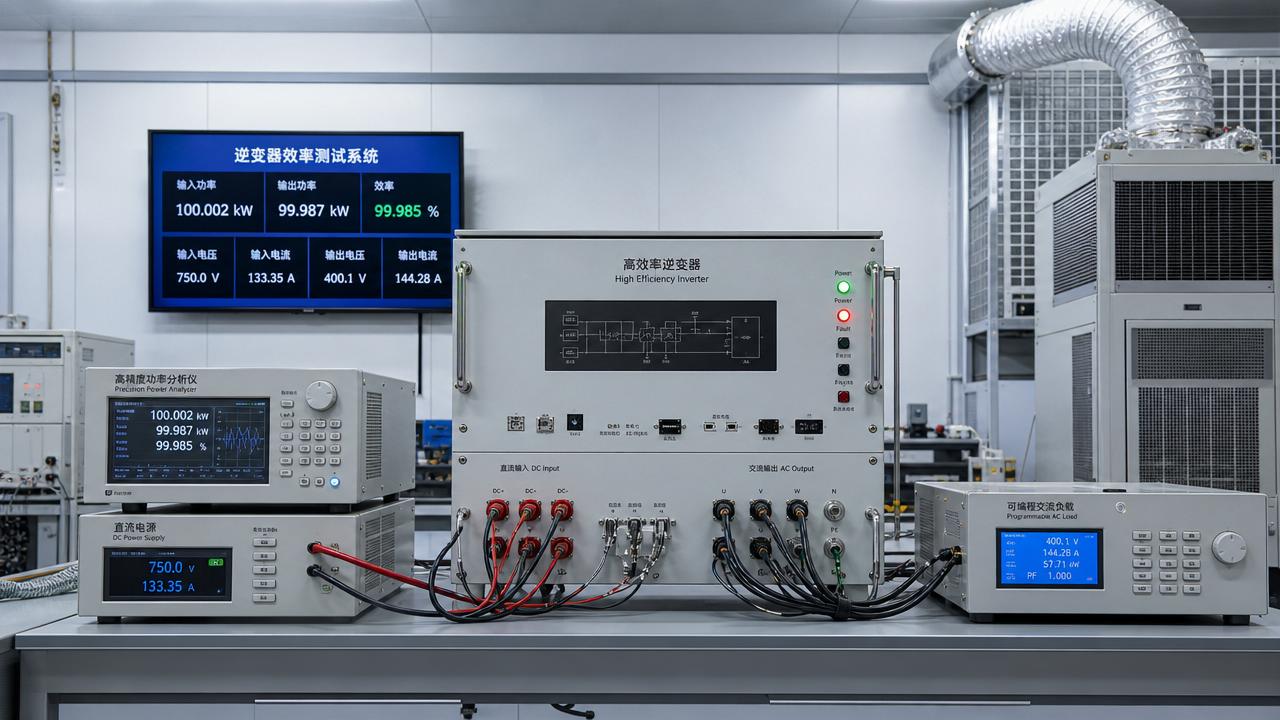
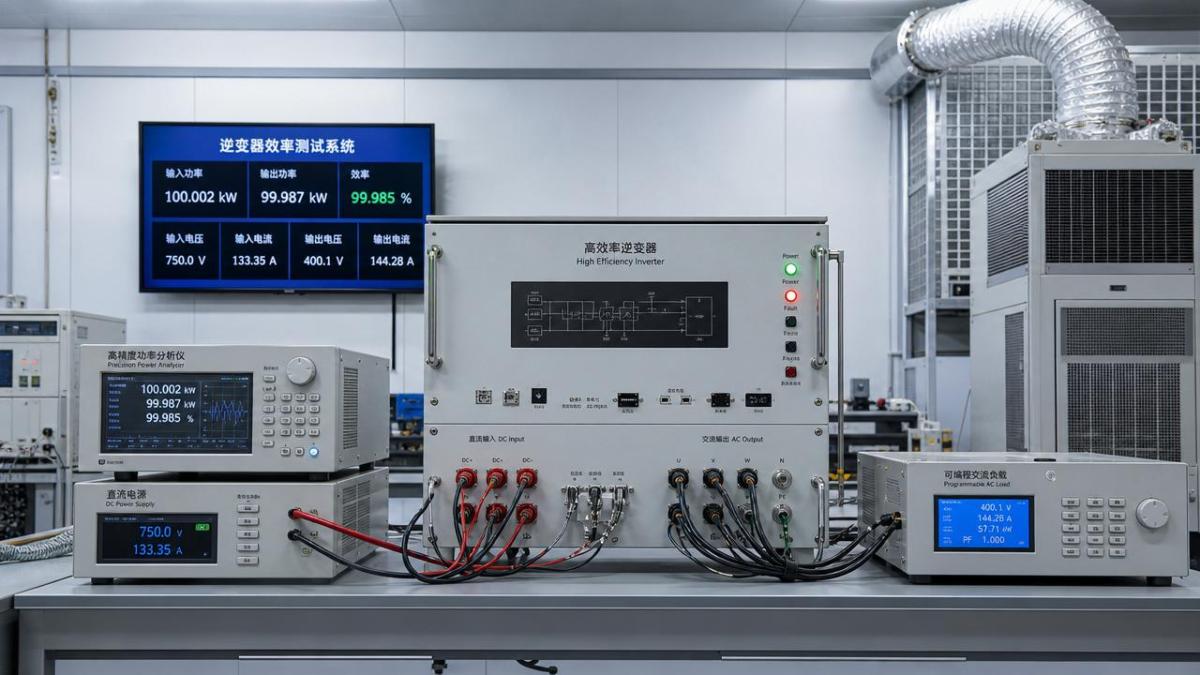
Verifying inverter conversion efficiency above 99% is not a datasheet review exercise. It is a measurement discipline requiring traceability, repeatability, and context.
For technical evaluators, the practical question is whether the inverter sustains 99%+ efficiency under relevant operating conditions, not only at one optimized point.
A credible verification program must control input power, output loading, temperature, power factor, harmonic behavior, and measurement uncertainty before accepting a 99%+ claim.
Start With the Right Question: Peak Efficiency or Bankable Efficiency?
Most inverter specifications highlight peak efficiency because it is the most favorable number. It usually occurs at a narrow load and voltage condition.
For procurement and asset evaluation, peak efficiency is less useful than weighted efficiency across the inverter’s expected operating envelope.
Solar, wind, storage, and grid-interactive systems rarely operate at rated power continuously. Partial-load performance often determines real annual energy yield.
A 99.1% peak efficiency claim may be less valuable than a 98.8% weighted efficiency with stronger thermal stability and lower derating risk.
Technical evaluators should therefore define the target metric before testing. The phrase inverter conversion efficiency means little without test boundaries.
For PV applications, European efficiency, CEC efficiency, or customized irradiance-weighted profiles may better represent project economics than peak laboratory efficiency.
For battery energy storage systems, round-trip operating modes, charge-discharge asymmetry, and auxiliary loads must be separated from pure power conversion efficiency.
Define the Efficiency Boundary Before Measuring Anything
The first verification step is deciding what enters the calculation. Boundary definition prevents misleading results and supplier-side interpretation disputes.
Basic conversion efficiency is output active power divided by input active power, expressed as a percentage under specified operating conditions.
However, evaluators must clarify whether cooling fans, control electronics, communication modules, contactors, transformer losses, and standby loads are included.
For a central inverter, cabinet auxiliary consumption can become material at lower load. Excluding it may overstate practical operating efficiency.
For string inverters, measurement boundaries must account for multiple MPPT channels, DC bus behavior, and internal power supply consumption.
In grid-scale BESS, the power conversion system, transformer, HVAC, EMS, and battery losses are often mixed incorrectly in commercial discussions.
A valid test report should state the electrical boundary, measurement points, cable compensation method, and whether auxiliary energy is included.
If these details are missing, a 99%+ efficiency statement cannot be treated as bankable technical evidence.
Use Standards as a Framework, Not as a Substitute for Engineering Judgment
International standards help create comparable conditions, but they do not remove the need for project-specific interpretation.
IEC 61683 is widely referenced for measuring efficiency of photovoltaic power conditioners, including static and dynamic behavior considerations.
For grid-connected inverters, evaluators may also consider IEC 62109 safety requirements, IEC 61727, IEEE 1547, and regional grid-code tests.
UL 1741 and related certification pathways matter in North American procurement, especially when advanced grid-support functions are enabled.
Standards-based testing establishes a minimum quality framework. It does not automatically prove that inverter conversion efficiency exceeds 99% in field operation.
Many standards allow defined test temperatures and controlled grid conditions. Actual sites may face higher ambient temperature, weak grids, or voltage excursions.
Therefore, the strongest validation combines certified laboratory tests, manufacturer design evidence, independent sampling, and project-specific performance modeling.
Build a Traceable Test Setup With Uncertainty Below the Efficiency Gap
Measuring above 99% efficiency is difficult because the loss being measured is extremely small. A 1 MW inverter losing 1% dissipates 10 kW.
If the measurement uncertainty is near the claimed improvement, the test cannot prove superiority. This is a common evaluation failure.
Use high-accuracy power analyzers with traceable calibration, suitable bandwidth, and synchronized voltage-current channels on both input and output sides.
Current transducers, voltage probes, shunts, and data acquisition systems must be selected for accuracy at the expected current, frequency, and waveform shape.
Measurement instruments should capture true active power, not apparent power. Harmonic-rich switching waveforms can distort simpler measurement systems.
The uncertainty budget should include instrument accuracy, transducer error, phase angle error, temperature drift, cable losses, sampling synchronization, and calibration status.
For a 99.05% claim, an uncertainty of plus or minus 0.3% is inadequate. It only confirms the inverter is generally efficient.
Independent laboratories often apply uncertainty analysis according to ISO/IEC 17025 principles. Procurement teams should request the full uncertainty statement.
Control Input Conditions, Output Loading, and Thermal State
Efficiency varies significantly with DC voltage, load percentage, switching mode, temperature, and grid conditions. A single measurement point is insufficient.
For PV inverters, test across minimum, nominal, and maximum MPPT voltage ranges. Some devices are most efficient only near an optimal DC voltage.
For storage inverters, test both charging and discharging directions. Bidirectional converters may not show symmetric loss profiles.
Load points should include low load, 25%, 50%, 75%, 100%, and any region where the manufacturer claims exceptional performance.
Thermal stabilization is essential. A cold inverter may temporarily outperform its steady-state efficiency before semiconductor junctions and magnetic components heat up.
Record ambient temperature, internal temperature, cooling mode, fan state, heat-sink temperature, and test duration at each load point.
If efficiency drops after one hour of operation, the initial reading should not be used as evidence of sustained 99%+ performance.
For outdoor and utility-scale applications, evaluators should request thermal derating curves and validate them against expected site temperatures.
Account for Grid-Code Functions That Can Reduce Measured Efficiency
Modern inverters are not passive conversion devices. They provide reactive power, voltage regulation, frequency response, ride-through, and sometimes grid-forming functions.
These capabilities improve grid value, but they can change semiconductor stress, current flow, switching behavior, and apparent loss.
A test at unity power factor may not represent a project requiring continuous reactive power support or voltage control.
Technical evaluators should test efficiency at required power factor setpoints, including lagging and leading conditions where applicable.
Grid-code interactions are especially important for weak grids, high renewable penetration regions, and utility projects with strict interconnection agreements.
In some markets, an inverter with slightly lower conversion efficiency but stronger grid-support behavior may produce better compliance value.
Verification should therefore connect efficiency testing with the actual grid-access obligations of the project, not just laboratory convenience.
Compare Peak, Weighted, and Field-Adjusted Efficiency
A robust assessment separates three layers: peak efficiency, weighted efficiency, and field-adjusted efficiency under expected operating scenarios.
Peak efficiency identifies the best technical operating point. It is useful for design benchmarking but weak for energy-yield prediction.
Weighted efficiency applies load distribution factors. This helps compare inverter models under a standardized production profile.
Field-adjusted efficiency incorporates site temperature, DC sizing ratio, clipping, voltage window, curtailment, degradation assumptions, and grid-support dispatch.
For solar assets, a high DC-to-AC ratio may shift operation toward higher load periods, changing how often the inverter reaches its optimal zone.
For BESS assets, dispatch profiles determine whether the converter spends more time at high power, low power, or standby.
Evaluators should ask suppliers for efficiency maps, not only tables. A full map reveals valleys, thermal sensitivities, and operational trade-offs.
The best procurement decision comes from matching the efficiency map to the asset’s real duty cycle and revenue strategy.
Look for Red Flags in Manufacturer Efficiency Claims
Some efficiency claims are technically true but commercially misleading. Evaluators should identify wording that avoids full verification responsibility.
Phrases such as “up to 99%,” “maximum efficiency,” or “under ideal laboratory conditions” should trigger closer review.
Ask whether the value was measured by an accredited third-party laboratory, internal engineering team, or simulation-based estimate.
Check whether the test included transformer losses, auxiliary loads, reactive power operation, and thermal steady-state conditions.
Be cautious when the supplier provides only one voltage point, one load point, or a graph without axis details.
Another red flag is a missing uncertainty budget. Without uncertainty, the difference between 98.95% and 99.05% may be statistically meaningless.
For institutional procurement, require complete test reports, calibration certificates, test configuration diagrams, and serial-number traceability for tested units.
If the production batch differs from the tested prototype, request evidence that component changes have not altered loss performance.
Translate Efficiency Differences Into Project Value
Efficiency verification matters because small percentage differences become large economic differences at utility scale and over long asset life.
For a 100 MW solar plant, a 0.2% conversion efficiency improvement can represent meaningful annual energy gain, depending on operating hours.
However, evaluators should not overvalue efficiency in isolation. Reliability, availability, derating, maintainability, and grid compliance may dominate lifecycle economics.
A highly efficient inverter that trips frequently or derates under heat can underperform a slightly less efficient but more robust competitor.
Model the efficiency impact using expected production, PPA pricing, curtailment exposure, auxiliary consumption, and O&M cost assumptions.
For merchant or hybrid assets, dispatch timing matters. Loss reduction during high-price periods may be more valuable than average efficiency improvement.
Technical findings should therefore be translated into LCOE, LCOS, revenue capture, availability risk, and warranty enforceability.
This approach helps procurement teams avoid choosing a product based on a laboratory number that lacks financial relevance.
Recommended Verification Workflow for Technical Evaluators
Begin by defining the asset application, operating envelope, grid-code requirements, and efficiency metric that will influence the procurement decision.
Next, request the supplier’s complete efficiency map, test reports, standard references, uncertainty budget, and measurement boundary definition.
Review whether the reported conditions match project realities, especially voltage range, ambient temperature, load distribution, and reactive power obligations.
Then commission independent testing if the procurement volume, project risk, or claimed performance premium justifies additional verification.
The test plan should include steady-state thermal operation, multiple DC voltages, multiple load points, bidirectional modes where relevant, and power factor variation.
During testing, ensure all instruments are calibrated, measurement channels are synchronized, and data is recorded long enough to detect thermal drift.
After testing, compare measured values against the uncertainty budget. Do not treat a marginal result as proof unless confidence intervals support it.
Finally, incorporate verified efficiency into energy-yield models and commercial risk analysis before final supplier selection.
Conclusion: 99%+ Efficiency Must Be Proven, Not Assumed
Verifying inverter conversion efficiency above 99% requires disciplined measurement and clear interpretation. The number alone is not enough.
Technical evaluators should focus on boundary definition, traceable instrumentation, uncertainty analysis, thermal stability, load profiles, and grid-code operating modes.
The most reliable evidence is not a single peak value, but a tested efficiency map connected to real project duty cycles.
When verification is performed correctly, it supports stronger procurement decisions, more accurate yield forecasts, and better long-term asset bankability.
In a market where fractions of a percent influence returns, credible efficiency validation is a strategic safeguard, not a laboratory formality.
Deep Dive
Related Intelligence
- Which string cable loss metrics matter most in PV system design?Author :

- Next-Gen Solar Inverter Technology Grid-Forming: Key Performance Trade-OffsAuthor :

- Solar Inverter Harmonic Analysis: When Distortion Becomes a Cost IssueAuthor :

- How to Compare an Off-Grid Solar System Factory Supplier on Cost and Lead TimeAuthor :