How to Read Inverter Harmonic Distortion Data
Key Takeaways
- How grid access delays are reshaping renewable project timelines in Latin AmericaDr. Elena Volt
- What drives energy storage systems price per kWh for commercial projects?Dr. Julian Volt
- What manufacturers should compare in emissions tracking softwareLina Cloud
- Why high-net-worth buyers are reshaping demand for automotive technologyDr. Aris Sun
- Can project tender intelligence software improve bid opportunity quality?Lina Cloud
- Which metrics reveal whether a P2P energy trading platform is working?Lina Cloud
- When does strategic link acquisition improve a clean energy site's authority?Dr. Aris Sun
- What drives solar street lighting cost for a new installation?Dr. Aris Sun
Industry Overview
Our mission is to safeguard the future of global renewable energy development through verifiable data, interdisciplinary academic scrutiny, and unwavering industry integrity.
Accurately interpreting inverter harmonic distortion data is essential for technical evaluators assessing grid compliance, equipment reliability, and renewable energy project performance.
As inverter-based resources expand across solar, wind, storage, and smart-grid systems, harmonic behavior directly affects power quality and asset stability.
This guide explains how to read key distortion metrics, compare them against IEC and IEEE expectations, and identify grid-integration risks.
Why Inverter Harmonic Distortion Data Needs a Checklist
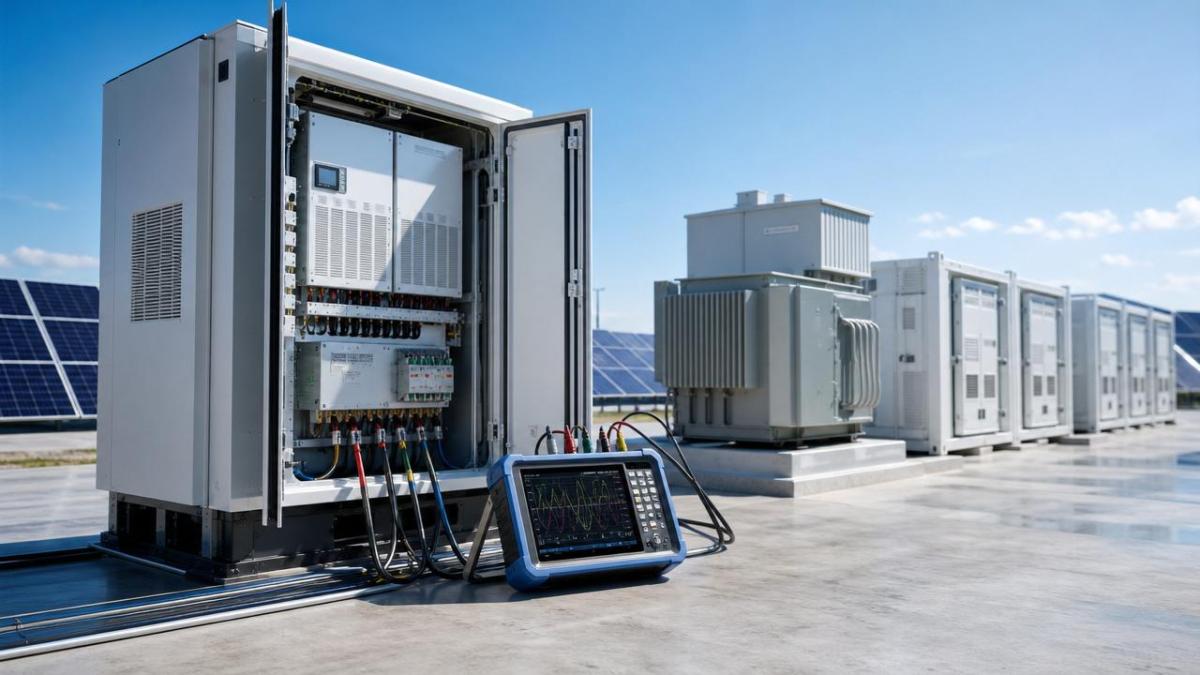
Inverter harmonic distortion data is rarely useful as a single number. It must be interpreted through operating mode, load level, and grid conditions.
A checklist prevents misreading test reports, factory datasheets, commissioning records, or continuous power-quality logs from utility-scale renewable assets.
For grid-connected solar, wind, BESS, and VPP-controlled systems, harmonic emissions can change sharply during curtailment, ramping, or weak-grid events.
Checklist-based review also supports consistent benchmarking against IEC 61000, IEEE 519, grid codes, and project-specific power-quality clauses.
Core Metrics in Inverter Harmonic Distortion Data
Start by separating current distortion, voltage distortion, individual harmonics, interharmonics, and total demand distortion before drawing conclusions.
Inverter harmonic distortion data should always identify whether values are measured at inverter terminals, transformer secondary, PCC, or grid interconnection.
A low THDi at the inverter does not automatically guarantee acceptable THDv at the point of common coupling.
Checklist for Reading Inverter Harmonic Distortion Data
Use this checklist when reviewing inverter harmonic distortion data from datasheets, type tests, commissioning reports, or operational monitoring platforms.
- Confirm the measurement location before comparing values, because terminal, feeder, transformer, and PCC readings reflect different network impedances.
- Check the operating load percentage, since distortion often rises at low output and may look better near rated power.
- Identify the reference standard used, such as IEC 61000 series, IEEE 519, local grid code, or project-specific limits.
- Separate THDi from THDv, because current emissions originate from equipment while voltage distortion reflects system response.
- Review individual harmonic orders, especially 5th, 7th, 11th, 13th, and switching-related components around filter resonance bands.
- Compare TDD against demand current, not momentary current, when using IEEE-style assessments for industrial or utility interconnection.
- Verify sampling duration and aggregation interval, because ten-cycle, three-second, ten-minute, and weekly records support different conclusions.
- Look for abnormal patterns during start-up, shutdown, ramp-rate control, reactive power control, and grid-forming mode transitions.
- Check whether filters, transformers, cables, and capacitor banks were included in the measurement boundary or excluded from results.
- Record grid short-circuit ratio, because weak networks amplify voltage distortion and make inverter harmonic distortion data more sensitive.
This process turns inverter harmonic distortion data into an engineering signal rather than a compliance checkbox.
How to Interpret THDi and THDv Together
THDi describes how distorted the inverter current waveform is relative to its fundamental current component.
THDv describes the resulting distortion in the voltage waveform at a defined electrical node.
When inverter harmonic distortion data shows high THDi but acceptable THDv, the grid may be strong enough to absorb emissions.
When THDv is high with moderate THDi, network impedance, resonance, or background distortion may be driving the issue.
The most serious cases combine rising THDi, rising THDv, and specific harmonic spikes near transformer or filter resonance frequencies.
Practical Reading Rule
Never accept inverter harmonic distortion data without load level, voltage level, frequency, measurement point, and operating mode.
Without those details, the report cannot support procurement comparison, grid-code verification, or root-cause analysis.
Interpreting Individual Harmonics
Individual harmonic orders often reveal more than total distortion values.
For three-phase inverters, the 5th and 7th harmonics commonly receive close attention during interconnection studies.
Higher-order components may indicate switching behavior, filter tuning issues, control instability, or interaction with nearby power-electronic assets.
- Track persistent 5th harmonic growth, because it can increase motor heating and indicate unfavorable converter-grid interaction.
- Investigate elevated 7th harmonic values, especially where transformers, cables, or compensation equipment create resonance amplification.
- Flag sudden high-order spikes, since they may reflect switching control problems or degraded filter components.
- Compare phase balance, because asymmetrical harmonic patterns can indicate sensor faults, grounding issues, or unequal feeder impedance.
Good inverter harmonic distortion data should include harmonic spectrum charts, not only summary THD numbers.
Reading Data Against IEC, IEEE, and Grid-Code Limits
IEC documents often guide equipment immunity, emissions, compatibility levels, and measurement methods for low-voltage and medium-voltage systems.
IEEE 519 focuses on harmonic control at the point of common coupling, with limits linked to system strength.
Local grid codes may impose stricter limits than either framework, especially for renewable plants connected to weak transmission corridors.
When inverter harmonic distortion data is assessed, confirm whether the limit applies to current, voltage, individual order, or aggregated value.
Also confirm whether background distortion is included or subtracted, because this can change compliance responsibility.
Compliance Comparison Steps
- Match the measurement point to the contractual compliance point before comparing reported values with grid-code thresholds.
- Use the correct current basis when reviewing TDD, especially in plants with variable renewable output.
- Separate planning limits from operational alarms, because they may support different engineering or contractual decisions.
- Document background distortion before energization, since the connected plant may not cause all measured harmonic voltage.
Application Notes for Solar, Wind, BESS, and Smart Grids
Utility-Scale Solar PV
In solar PV plants, inverter harmonic distortion data should be reviewed across irradiance transitions, curtailment, and reactive power dispatch.
Low-load morning and evening operation can produce different distortion levels than stable midday generation.
Wind Energy Conversion Systems
Wind projects need harmonic analysis during variable speed operation, fault ride-through behavior, and collection-system resonance studies.
Inverter harmonic distortion data should be paired with turbine converter settings and offshore cable impedance where applicable.
Battery Energy Storage Systems
BESS assets require separate review for charging, discharging, standby, black-start, and grid-forming control modes.
The same inverter may show different harmonic behavior when providing frequency response, voltage support, or synthetic inertia.
Energy Internet and VPP Platforms
Aggregated distributed inverters can create harmonic diversity, but synchronized control actions may also concentrate emissions.
For VPP portfolios, inverter harmonic distortion data should be filtered by device type, feeder location, and dispatch command.
Common Overlooked Risks in Harmonic Review
Ignoring weak-grid conditions: A report from a strong test network may understate voltage distortion in remote renewable corridors.
Relying only on rated-power results: Inverter harmonic distortion data at partial load may reveal emissions hidden during nameplate testing.
Missing resonance studies: Harmonic levels can remain acceptable until capacitor banks, cables, or transformers shift the system response.
Overlooking firmware changes: Control updates can alter switching patterns, harmonic compensation, and grid-support behavior after commissioning.
Confusing alarms with violations: Monitoring alerts may use conservative thresholds that do not equal contractual non-compliance.
Practical Execution Advice
Build a review file that links inverter harmonic distortion data with one-line diagrams, transformer ratings, cable data, and PCC definitions.
Request raw harmonic spectra where possible, because exported summaries can hide short-duration events and individual order exceedances.
Use trend analysis rather than one-time readings when evaluating operational plants.
A stable trend with low THDv is usually less concerning than a rising trend linked to specific dispatch modes.
- Standardize report templates so each dataset includes measurement point, load condition, standard reference, and aggregation interval.
- Benchmark multiple inverter models under comparable grid strength before using distortion values for technical selection.
- Schedule periodic power-quality surveys after firmware updates, plant expansions, or changes to compensation equipment.
- Escalate recurring individual harmonic spikes for simulation, field measurement, and filter coordination review.
For complex projects, combine measured inverter harmonic distortion data with electromagnetic transient studies and steady-state harmonic simulations.
Summary and Action Guide
Reading inverter harmonic distortion data requires context, not just comparison against a percentage limit.
The essential checks are measurement location, operating mode, standard reference, individual harmonic spectrum, and grid strength.
Use THDi to understand emission behavior, THDv to evaluate system impact, and TDD to support IEEE-style compliance decisions.
Before accepting any report, verify the PCC definition, background distortion, sampling interval, and inclusion of filters or transformers.
The next step is to create a project checklist and apply it consistently across solar, wind, BESS, and smart-grid assets.
With disciplined review, inverter harmonic distortion data becomes a practical tool for compliance, reliability, and bankable renewable infrastructure decisions.
Deep Dive
Related Intelligence
- Which string cable loss metrics matter most in PV system design?Author :

- Next-Gen Solar Inverter Technology Grid-Forming: Key Performance Trade-OffsAuthor :

- Solar Inverter Harmonic Analysis: When Distortion Becomes a Cost IssueAuthor :

- How to Compare an Off-Grid Solar System Factory Supplier on Cost and Lead TimeAuthor :