Solar Inverter OEM Factory Selection: Quality Risks and Lead Time Signals
Key Takeaways
- SGEI 2026 Call for Papers: VPP Interoperability Certification in Focus
- Trina Storage Signs 233MW/1003MWh Grid-Forming Project in Chile: Latin America’s GFM Standards Accelerate Localization
- China’s Second ‘Mother Rivers Revival Action’ Extends UHV Substation EIA Timelines
- TrendForce Raises 2027 Memory Revenue Forecast to $128B Amid Liquid-Cooled BESS Demand
- China’s New Commercial Secret Rules Take Effect June 2026
- Off-Grid Solar System Factory: Inverter Specs to Compare FirstDr. Aris Sun
- Car Infotainment Reliability: Common Upgrade Mistakes to AvoidDr. Aris Sun
- Custom Farming Equipment: Static Load Checks That Prevent FailuresDr. Julian Volt
Industry Overview
Our mission is to safeguard the future of global renewable energy development through verifiable data, interdisciplinary academic scrutiny, and unwavering industry integrity.
Choosing a solar inverter OEM factory is no longer just a price comparison—it is a strategic risk decision tied to product reliability, certification integrity, and project delivery certainty. For commercial evaluators, the earliest warning signs often appear in quality-control systems, engineering transparency, and lead time consistency. This article outlines the signals that help identify dependable manufacturing partners before hidden defects or supply delays disrupt utility-scale procurement.
Why does solar inverter OEM factory selection now carry greater procurement risk?
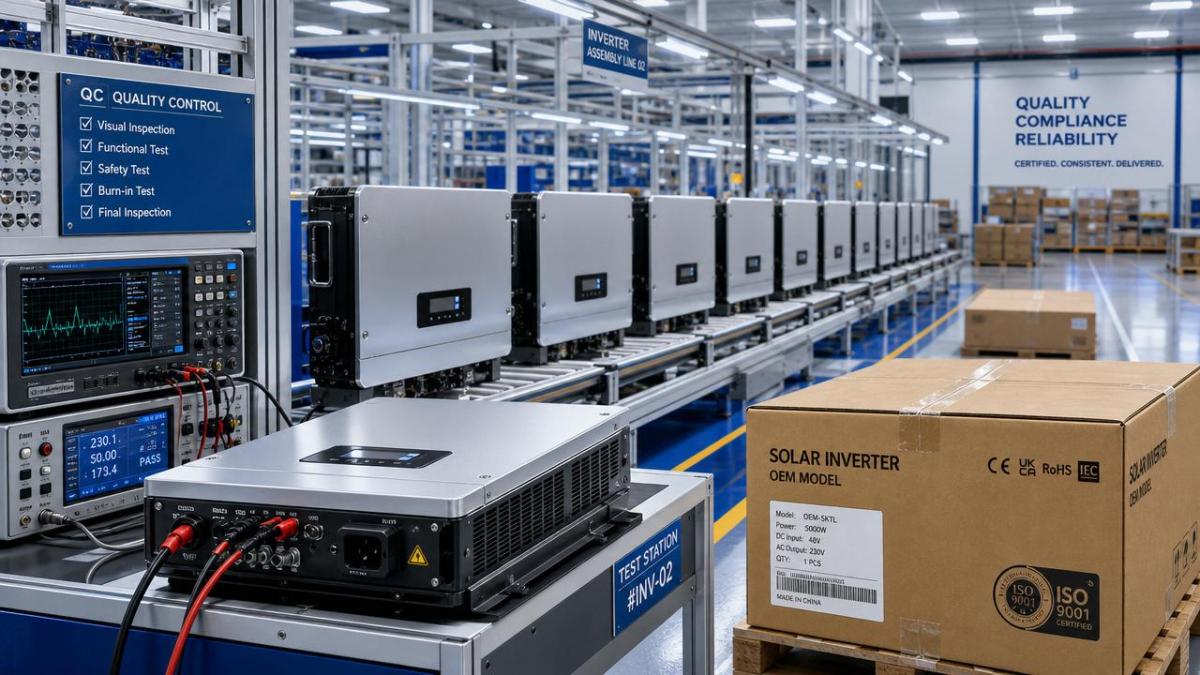
In the renewable energy supply chain, the inverter has moved from being a replaceable balance-of-system item to a grid-critical control asset. A weak solar inverter OEM factory can introduce not only hardware failure risk, but also schedule slippage, certification disputes, and long-tail warranty exposure.
For business evaluators working on utility, C&I, or hybrid storage projects, the real challenge is that many suppliers look similar on brochures. The difference appears in process discipline, firmware governance, supplier traceability, and whether lead times remain stable when order volume rises.
At G-REI, benchmarking across solar PV, storage, smart distribution, and grid software shows a consistent pattern: projects fail less often when procurement teams assess manufacturing behavior, not just nominal specifications. That means checking how the factory manages deviations, component substitutions, and compliance records under pressure.
- Price-only evaluation often misses hidden costs such as delayed commissioning, field replacement labor, and re-certification requirements.
- Lead time promises without capacity evidence can expose EPC schedules to liquidated damages or interconnection delays.
- Limited engineering transparency can signal future problems in firmware updates, fault handling, and grid-code adaptation.
Which early quality signals reveal a dependable solar inverter OEM factory?
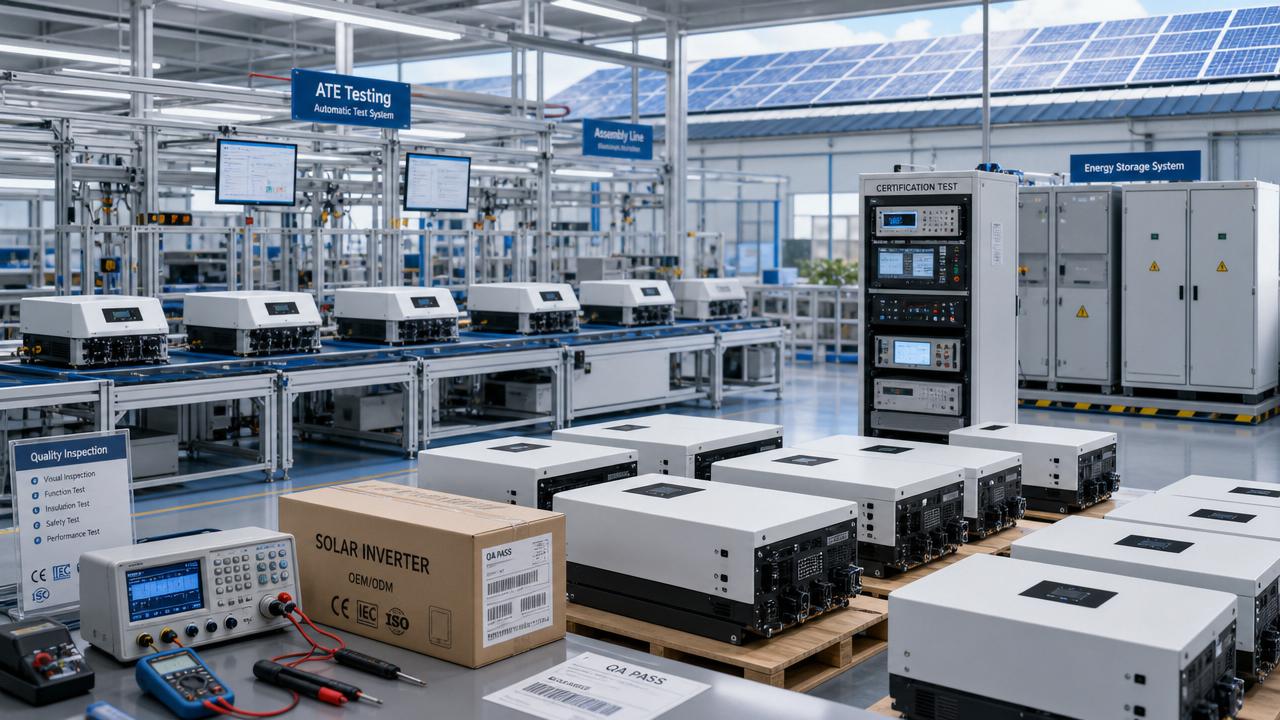
Commercial evaluators need observable signals, not marketing claims. A credible solar inverter OEM factory usually demonstrates mature incoming inspection, in-process controls, final testing logic, and documented change management. If those systems are vague, the quality risk is usually transferred downstream to the buyer.
The table below highlights practical quality indicators that can be checked during supplier qualification, desktop review, or on-site audit.
A strong solar inverter OEM factory does not hide behind generic QA language. It can explain what is inspected, when it is inspected, what triggers a stop, and how nonconforming units are segregated. That level of detail matters more than presentation polish.
Questions procurement teams should ask during audit
- How are critical components qualified when the original supplier faces shortage or pricing volatility?
- Which tests are performed on every unit, and which tests are sampled by batch?
- What is the approval path for firmware revisions, and how are field units identified by software version?
- Can the factory provide serial-level traceability linking finished goods to core electronic components?
How should buyers read lead time signals beyond the quoted delivery date?
A quoted lead time is only the visible layer. The more useful question is whether the solar inverter OEM factory can sustain that timeline across engineering review, material allocation, pilot run, mass production, and outbound inspection. Reliable lead time comes from process stability, not from sales commitment.
For cross-border renewable procurement, delays often start upstream. Semiconductor availability, magnetics capacity, enclosure fabrication, and test bench bottlenecks can each break delivery promises. Buyers should therefore ask for stage-based schedules rather than a single shipping week.
The following comparison helps evaluators distinguish healthy lead time behavior from risky supplier responses.
The best factories are often conservative in what they promise and specific in how they plan. That is usually a better signal than an aggressive date unsupported by procurement, production, and testing logic.
Practical lead time checkpoints
- Separate prototype, pilot, and mass production timelines rather than combining them into one quotation.
- Ask which components have procurement cycles longer than the promised factory lead time.
- Confirm whether certification labels, packaging, and communications protocols are already frozen for your project region.
- Check if final testing capacity scales with volume or becomes a hidden bottleneck.
What standards and documentation should a solar inverter OEM factory handle well?
Inverter procurement in the global energy market is shaped by more than electrical performance. Compliance, grid behavior, safety records, and document control directly affect acceptance by EPC contractors, financiers, insurers, and utility reviewers. A competent solar inverter OEM factory should be comfortable operating within internationally recognized frameworks such as IEC, UL, and applicable grid interconnection requirements.
For evaluators, the critical issue is not whether a supplier mentions standards, but whether it can connect them to product configuration, test evidence, and regional shipment execution.
- Safety documentation should align with actual hardware variants, not only a generic family brochure.
- Grid-support functions such as reactive power control, ride-through behavior, and communication compatibility should be traceable to firmware versions.
- Nameplate data, user manuals, test reports, and packaging labels must remain consistent with the ordered configuration.
Documentation gaps that often delay projects
One common issue is mismatch between certified configuration and shipped BOM. Another is incomplete communication documentation when the inverter must integrate with plant controllers, SCADA, or energy management systems. In hybrid and smart-grid projects, these “paper gaps” can stall site acceptance even when the hardware arrives on time.
G-REI’s cross-sector benchmarking is useful here because inverter selection increasingly intersects with storage dispatch logic, digital substations, and grid-code compliance. Buyers should therefore evaluate a factory’s document discipline with the same seriousness as thermal design or conversion efficiency.
How can business evaluators compare factories without getting lost in technical noise?
Many procurement reviews fail because teams compare too many unweighted features. A more effective approach is to score the solar inverter OEM factory on decision-critical categories tied to project risk, total cost, and execution confidence.
The matrix below can be adapted for prequalification, request-for-quotation review, or final supplier nomination.
This framework helps evaluators move from feature collection to risk ranking. It also supports cross-functional discussion between procurement, engineering, and compliance teams, which is especially important for institutional buyers managing large or multi-country renewable portfolios.
What mistakes do buyers make when sourcing from a solar inverter OEM factory?
Several repeat mistakes appear across the market. The first is assuming that a sample pass means production consistency. The second is treating certificates as static documents rather than configuration-dependent evidence. The third is accepting short lead times without checking whether component allocation has been secured.
A further mistake is separating inverter review from the broader energy system. In modern projects, the inverter interacts with storage controls, plant-level monitoring, dispatch commands, and grid support requirements. A factory that cannot discuss these interfaces may still build hardware, but may not support project-level performance.
- Do not rely only on brochure efficiency and MPPT range when the project depends on curtailment logic, remote control, or hybrid operation.
- Do not treat packaging and labeling as minor details if customs, financing, or site audit requirements are strict.
- Do not ignore serviceability, spare parts planning, and firmware update governance in long-life energy assets.
FAQ: what do commercial evaluators ask most often?
How do I verify whether a solar inverter OEM factory is truly OEM-capable?
Look for control over engineering change, documentation, test processes, and configurable production rather than just private labeling. A real OEM-capable factory should explain how it handles firmware adaptation, branding control, communication options, and region-specific compliance without disrupting traceability.
What is a realistic lead time for inverter OEM projects?
There is no universal number because scope varies by certification status, component allocation, customization depth, and order volume. A more useful benchmark is whether the supplier can break the schedule into engineering confirmation, material readiness, pilot approval, production, testing, and shipment. If that breakdown is missing, the quoted date is less reliable.
Which documents should be requested before nomination?
Request a controlled specification sheet, test scope summary, certification mapping by product variant, communication protocol details, change-control process, and draft delivery plan. For grid-connected projects, ask how firmware versions are tied to grid-support functions and field upgrade procedures.
Is the lowest inverter price usually the best commercial option?
Often no. A lower ex-works price can be offset by schedule disruption, additional site troubleshooting, spare parts complexity, or certification mismatch. For institutional procurement, total commercial exposure matters more than unit price alone.
Why work with G-REI when evaluating a solar inverter OEM factory?
G-REI supports business evaluators with a broader decision framework than a single-product comparison. Because our intelligence spans advanced PV, energy storage, smart power distribution, and Energy Internet platforms, we assess inverter suppliers in the context that matters most: grid behavior, project bankability, integration readiness, and supply-chain credibility.
If you are screening a solar inverter OEM factory for utility-scale, C&I, or smart-grid deployment, we can help you review parameter fit, supplier risk signals, lead time logic, documentation readiness, and compliance alignment. We can also support discussions around customization scope, sample validation focus points, communication interfaces, and quotation comparisons.
Contact us to discuss supplier shortlisting, technical parameter confirmation, certification requirements, delivery schedule review, OEM customization boundaries, sample support priorities, and commercial quotation evaluation. For complex renewable procurement, better factory selection at the start usually prevents far more costly correction later.
Deep Dive
Related Intelligence