Solar Inverter OEM Factory: Key Quality Risks
Key Takeaways
- How grid access delays are reshaping renewable project timelines in Latin AmericaDr. Elena Volt
- What drives energy storage systems price per kWh for commercial projects?Dr. Julian Volt
- What manufacturers should compare in emissions tracking softwareLina Cloud
- Why high-net-worth buyers are reshaping demand for automotive technologyDr. Aris Sun
- Can project tender intelligence software improve bid opportunity quality?Lina Cloud
- Which metrics reveal whether a P2P energy trading platform is working?Lina Cloud
- When does strategic link acquisition improve a clean energy site's authority?Dr. Aris Sun
- What drives solar street lighting cost for a new installation?Dr. Aris Sun
Industry Overview
Our mission is to safeguard the future of global renewable energy development through verifiable data, interdisciplinary academic scrutiny, and unwavering industry integrity.
Selecting a solar inverter OEM factory is not just a sourcing decision—it is a quality and safety risk management task. For quality control and safety managers, hidden failures in components, thermal design, testing discipline, and compliance execution can directly affect field reliability, fire risk, and project bankability. This article outlines the key quality risks that should be identified before approving any OEM partner.
Why does a solar inverter OEM factory create hidden risk beyond price and lead time?
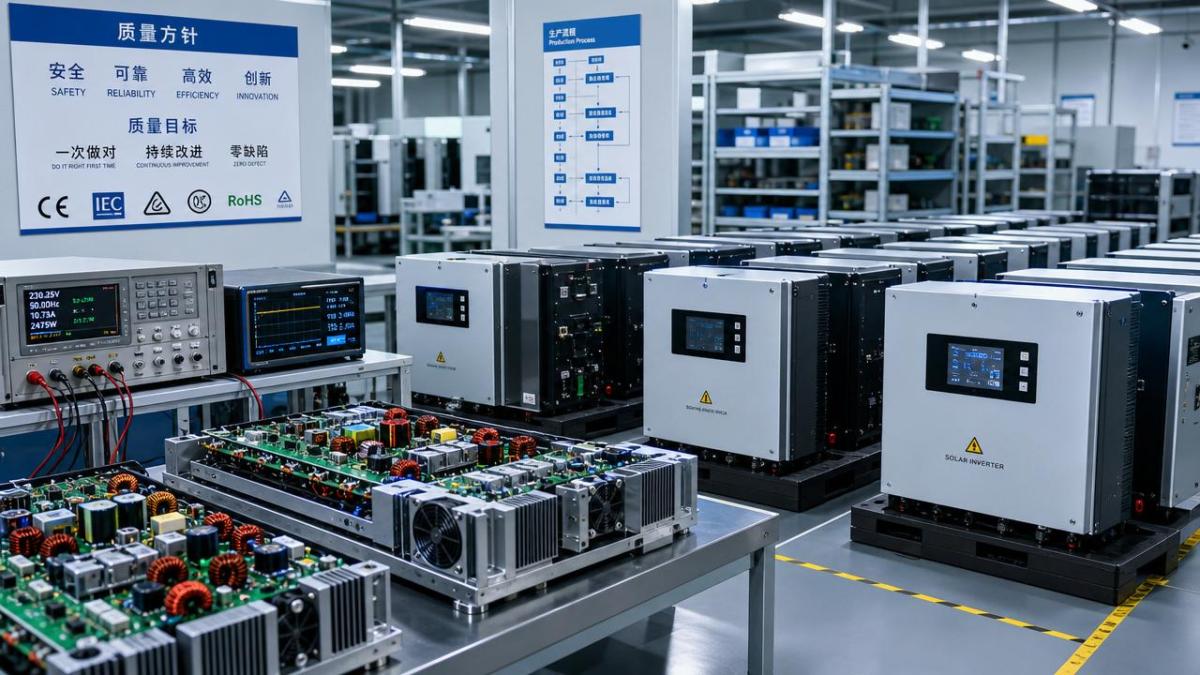
In the renewable energy supply chain, a solar inverter OEM factory sits at the intersection of power electronics, software control, thermal safety, and grid compliance. That means defects are rarely isolated. A weak capacitor selection can escalate into overheating, derating, nuisance shutdowns, and warranty disputes in the field.
For quality and safety teams, the real question is not whether the factory can assemble a unit. It is whether the manufacturer can control process variation, document critical-to-quality points, and sustain compliance across batch production, engineering changes, and export markets.
This is where G-REI adds value. By benchmarking energy hardware against IEC, IEEE, and UL-oriented expectations, and by tracking project delivery realities across PV, storage, and smart-grid applications, G-REI helps decision-makers connect factory-level quality signals to project-level operational risk.
- A low quoted price may reflect downgraded semiconductors, uncontrolled subcontracting, or reduced burn-in time.
- Fast delivery may mean incomplete validation on firmware, EMC, or environmental endurance.
- An acceptable sample may still hide unstable mass-production quality if incoming inspection and traceability are weak.
What are the key quality risks in a solar inverter OEM factory?
Quality risk in a solar inverter OEM factory usually concentrates in a few repeatable categories. These categories matter because inverter failures often begin with small deviations that escape incoming inspection but appear later under thermal cycling, humidity, harmonics, or grid disturbance conditions.
1. Component authenticity and lifecycle control
Power semiconductors, electrolytic capacitors, magnetic components, relays, connectors, and fans directly determine inverter lifetime. If the OEM cannot prove approved vendor lists, lot traceability, storage control, and obsolescence management, quality managers should treat the factory as high risk.
2. Thermal design and enclosure safety
Many field failures are thermal failures in disguise. Poor heat-sink contact, wrong TIM application, airflow blockage, and unrealistic ambient assumptions can reduce component life dramatically. In dusty, coastal, or high-altitude projects, the thermal margin should be questioned even more aggressively.
3. Process discipline on PCB assembly and final integration
Surface-mount soldering, busbar torque control, conformal coating consistency, cable routing, and creepage-clearance execution are not cosmetic issues. They directly affect arcing risk, hot spots, insulation durability, and vibration resistance during transport and operation.
4. Firmware maturity and protection logic
A solar inverter OEM factory may present strong hardware but unstable software. Anti-islanding behavior, fault recovery, MPPT logic, grid-code adaptation, and event logging must be validated under multiple abnormal conditions. Weak firmware change control can turn a compliant product into a field-risk product after a routine update.
5. Compliance execution versus compliance claims
Some factories know the language of certification better than the discipline of certification. Safety managers should distinguish between having test reports, maintaining certified production consistency, and applying market-specific requirements correctly across actual shipments.
Which factory audit points should quality and safety managers verify first?
Before approving a solar inverter OEM factory, teams need an audit structure that moves from visible claims to verifiable controls. The table below is useful during supplier qualification, sample review, and pre-mass-production assessment.
A strong audit does not stop at certificates on the wall. It should reveal whether the solar inverter OEM factory can preserve quality under schedule pressure, alternate sourcing, and market-specific customization. That is often where hidden risk appears.
- Ask for production records from three different batches, not only from the golden sample batch.
- Review nonconformance handling and corrective action closure time, not just defect counts.
- Check whether outsourced steps are included in the same quality system and traceability chain.
How should you compare OEM factories for safety-critical inverter procurement?
Not every solar inverter OEM factory presents risk in the same way. Some are weak in design control, some in process execution, and some in export compliance. A side-by-side evaluation helps procurement, quality, and EHS teams align on acceptance thresholds.
This comparison matters because the cheapest qualified sample is not always the safest fleet decision. A lower-risk solar inverter OEM factory may appear more expensive up front, yet cost less through fewer site failures, fewer claim disputes, and better insurer confidence.
Which standards and compliance checks should not be treated as paperwork?
In inverter procurement, compliance is often misunderstood as a one-time certificate review. For quality and safety managers, the better approach is to check whether the factory can consistently manufacture the same compliant configuration that was originally assessed.
Key areas to review
- Electrical safety architecture, including insulation coordination, protective earth continuity, and touch-safe design.
- EMC behavior under realistic installation conditions, especially where storage, EV charging, or sensitive control systems share the same network.
- Grid-code adaptability for export markets, because reactive power behavior, ride-through requirements, and anti-islanding logic differ by region.
- Environmental ratings and enclosure integrity, especially for projects facing salt mist, dust ingress, condensation, or high daytime thermal stress.
G-REI’s cross-sector perspective is useful here because inverter quality cannot be separated from broader grid-interaction realities. In a smart-grid environment, compliance affects not only product legality but also dispatch stability, fault response, and long-term asset bankability.
What practical warning signs appear during sampling, pilot orders, and factory visits?
A solar inverter OEM factory often reveals its real maturity during transitional stages: engineering sample, pilot lot, first mass production, and post-change batches. These are the moments when documentation gaps and weak process ownership become visible.
Red flags worth escalating
- The sample passes, but the factory cannot provide stable test scripts, calibration records, or serial-number traceability for production units.
- The engineering team promises firmware fixes, but there is no formal release matrix connecting software version, hardware revision, and market destination.
- Operators rely on verbal instructions for torque, sealing, or insulation checks instead of controlled work instructions.
- Rework areas are active, yet failure modes are not categorized in a way that supports meaningful corrective action.
- The factory resists sharing derating criteria for high ambient temperature, altitude, or overload duration.
For safety managers, these warning signs should trigger containment plans, additional witness testing, or a phased approval rather than full-scale onboarding. It is safer to delay approval than to inherit systemic field failure exposure.
How can procurement teams turn risk findings into a practical supplier approval process?
A disciplined approval process makes solar inverter OEM factory selection more objective. It also reduces internal friction between sourcing, engineering, quality, and project delivery teams. The process should not end at price negotiation or sample sign-off.
Recommended approval sequence
- Define application risk: utility-scale, C&I rooftop, hybrid storage coupling, remote site, harsh climate, or safety-sensitive facility.
- Set mandatory gates: required standards, grid functions, thermal derating limits, traceability depth, and after-sales response commitments.
- Run desk review: BOM policy, validation reports, quality manual, CAPA examples, and shipment-market compliance mapping.
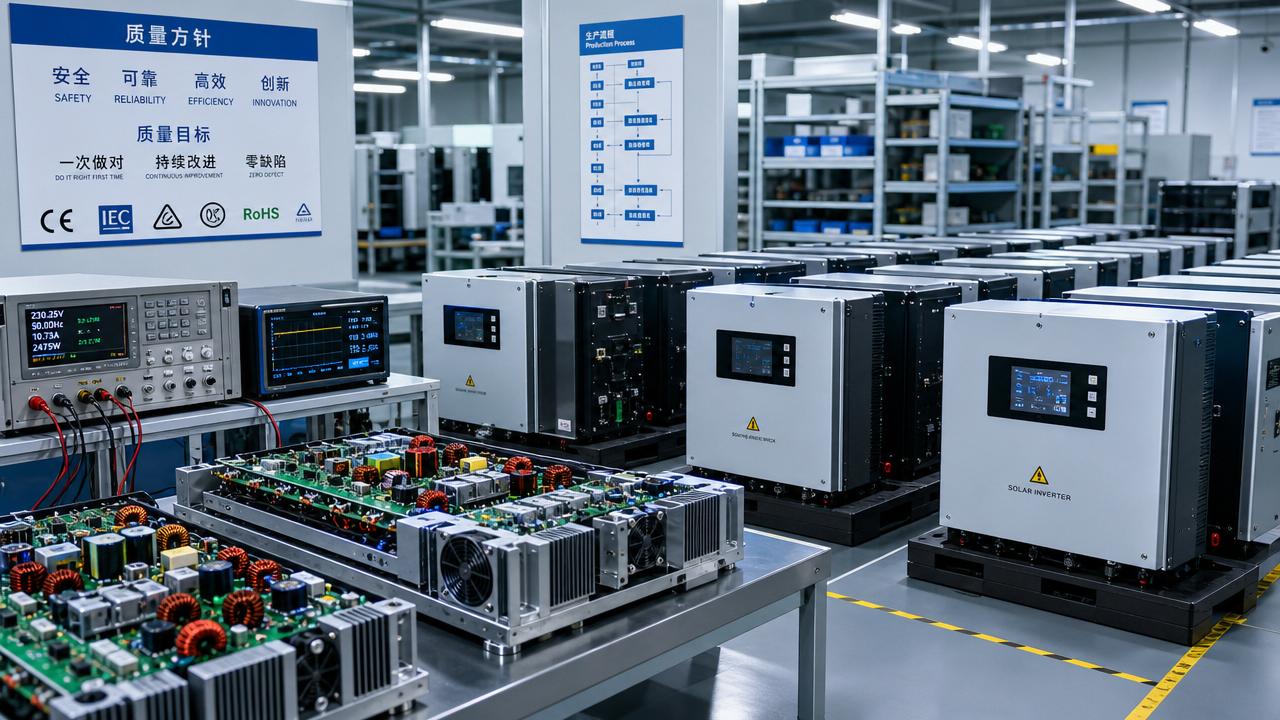
- Conduct factory audit: observe material handling, assembly controls, testing stations, rework segregation, and record discipline.
- Execute pilot validation: witness test critical protections, review environmental and thermal performance, and compare sample versus pilot consistency.
- Approve conditionally or fully: link approval level to corrective action closure, change notification rules, and periodic performance reviews.
This structured approach is especially effective when supported by G-REI benchmarking. Technical procurement becomes stronger when factory evidence is compared against international norms, project tender expectations, and evolving grid-access requirements across regions.
FAQ: what do quality and safety managers ask most about a solar inverter OEM factory?
How do I verify whether a solar inverter OEM factory is hiding component substitutions?
Ask for approved vendor lists, purchase records by batch, and engineering change documentation tied to serial numbers. Then compare sample teardown findings with pilot and production documentation. If alternate components appear without formal approval and revalidation logic, treat the supplier as high risk.
Which tests matter most before first-volume approval?
Focus on protection behavior, thermal stability, insulation integrity, functional consistency, and event logging quality. For demanding projects, add witness testing under elevated ambient conditions, voltage fluctuation, and repeated start-stop cycles. A routine pass/fail sheet alone is not enough.
Is certification enough to clear safety concerns?
No. Certification supports confidence, but production consistency is equally important. The real issue is whether the certified configuration remains unchanged and whether the factory can prove process control over every critical safety characteristic.
What if budget pressure pushes us toward a lower-cost OEM?
Use a total-risk view. Lower upfront pricing can become more expensive through site visits, downtime, insurance concerns, replacement logistics, and delayed project acceptance. Negotiate scope, validation depth, and phased release terms before accepting weak quality visibility.
Why choose us for solar inverter OEM factory evaluation and sourcing support?
G-REI supports quality control managers, safety leaders, and procurement teams who need more than a supplier brochure. Our value lies in connecting factory evidence to operational risk across solar PV, grid-scale storage, smart distribution, and energy internet applications.
- We help review technical parameters, thermal assumptions, protection logic, and grid-function expectations before vendor approval.
- We support supplier comparison for product selection, pilot qualification, and compliance-gap identification across target markets.
- We help clarify delivery risk, customization boundaries, firmware control concerns, and documentation requirements for audits and tenders.
- We can assist with sample evaluation priorities, quotation communication, and practical checkpoints for certification-sensitive projects.
If your team is assessing a solar inverter OEM factory, contact us with your target application, certification requirements, expected delivery window, and quality concerns. We can help you validate supplier risk, compare options, and define a more defensible approval path before large-volume commitment.
Deep Dive
Related Intelligence
- Which string cable loss metrics matter most in PV system design?Author :

- Next-Gen Solar Inverter Technology Grid-Forming: Key Performance Trade-OffsAuthor :

- Solar Inverter Harmonic Analysis: When Distortion Becomes a Cost IssueAuthor :

- How to Compare an Off-Grid Solar System Factory Supplier on Cost and Lead TimeAuthor :