
Which module suppliers are winning floating solar project contracts?
Key Takeaways
- Australian Energy Minister Seeks Mandatory Energy Contracts for Data CentresDr. Elena Volt
- Can a renewable energy planning platform estimate solar yield?Dr. Aris Sun
- Portugal Mandates Grid-Forming Capability for Large Storage, Launches 1 GW TenderDr. Elena Volt
- Can distributed energy systems keep commercial buildings powered during outages?Dr. Elena Volt
- China Sets Wind Power Capacity Credit Target of Around 11% by 2030Marcus Wind
- How to verify a solar water pumping system exporter's flow ratingsDr. Aris Sun
- IRENA Warns Global Clean Energy Additions Could Fall in 2026 as Grid Constraints BiteDr. Elena Volt
- What tests should a three-phase hybrid solar inverter factory run?Dr. Aris Sun
Industry Overview
Our mission is to safeguard the future of global renewable energy development through verifiable data, interdisciplinary academic scrutiny, and unwavering industry integrity.
Which module suppliers are winning floating solar project contracts?
Trina Solar, LONGi, and JA Solar have documented floating photovoltaic project references that make them relevant names for a supplier shortlist. But those references do not establish a current global ranking. Floating solar awards are disclosed unevenly, and a supplier’s appearance in project news does not always mean a binding module contract has been signed.
For anyone searching “floating solar project news module suppliers,” the practical challenge is separating confirmed supply relationships from framework agreements, tender participation, and general partnerships. The more useful question is not simply who appears most often in headlines. It is which suppliers can demonstrate project-specific suitability, credible delivery commitments, and warranty support that survives scrutiny.
Viewed through the technical and commercial intelligence lens of Global Renewable Energy & Smart-Grid Infrastructure (G-REI), contract evidence should sit alongside module durability, financing acceptability, and integration risk. A recognizable brand is a starting point—not the conclusion of an evaluation.
Named suppliers with documented floating PV references
Three established projects illustrate how major module manufacturers have secured positions in floating solar. These are historical references, not a live award leaderboard; they should be checked against original project and supplier disclosures before being used in an investment memorandum.
Useful verification sources include Sembcorp’s Tengeh opening announcement and Trina Solar’s related project material; Masdar and PLN disclosures on Cirata alongside LONGi’s reporting; and EGAT’s Sirindhorn project information alongside JA Solar’s supply announcement. Owner disclosures help establish the asset and operating milestone. Supplier disclosures help identify the module relationship. Neither necessarily reveals contract pricing, warranty negotiations, or the full procurement history.
These examples support a defensible conclusion: established utility-scale manufacturers have translated their broader solar businesses into floating PV supply positions. They do not prove that those manufacturers lead recent awards, dominate every region, or remain the preferred choice for a new site. Comparable operating references matter, but their relevance depends on exposure, mounting configuration, and the actual module model supplied.
A project announcement is not always a module award
Floating solar news often names developers, engineering contractors, float manufacturers, and module suppliers together. Their commercial roles are different. A floating-platform company may announce a major project without selecting the modules. An engineering, procurement, and construction contractor may win the main contract while module procurement remains open.
The evidence becomes more useful when the announcement identifies the supplier, project, contracted scope, and delivery status. A signed supply agreement is stronger evidence of an award than a memorandum of understanding. Delivered modules establish a later milestone; commercial operation confirms deployment, but not necessarily long-term reliability.
- Partnership or framework agreement: indicates commercial intent, potentially without committed project volume.
- Preferred supplier selection: suggests procurement progress, but may remain conditional.
- Executed project supply contract: supports an award claim, subject to any disclosed conditions.
- Shipment, installation, or commissioning: provides evidence that the supply relationship progressed into execution.
Capacity also needs checking. Module supply is generally expressed in DC peak capacity, while project announcements may emphasize AC export capacity. Confusing the two can create a false mismatch or exaggerate a supplier’s contribution. Expansions, phased deliveries, and repeated announcements can also lead to the same volume being counted twice.
Why suppliers win: suitability matters beyond the datasheet
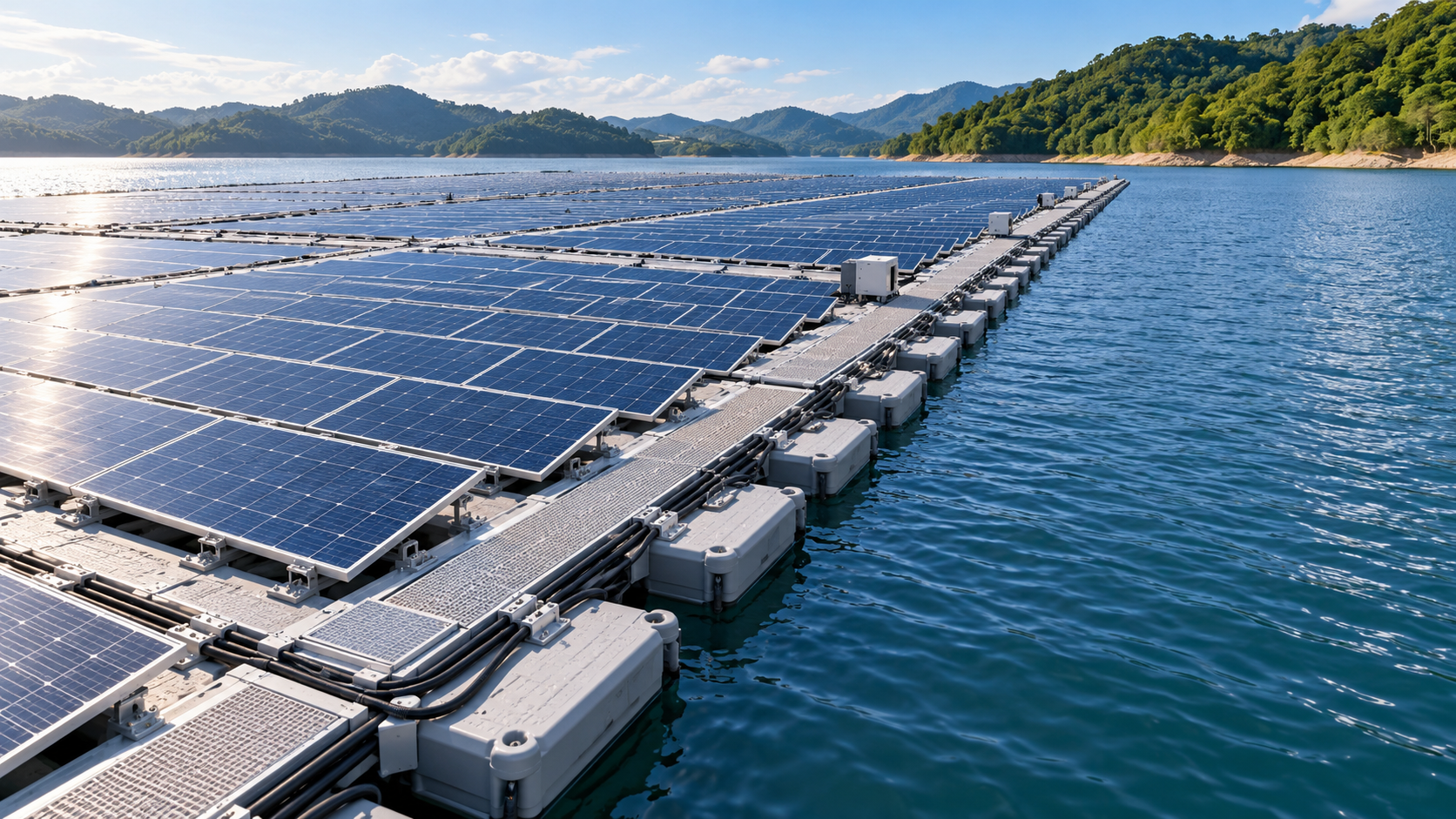
Floating PV places familiar solar equipment inside a less familiar mechanical and environmental system. Modules remain above water, but their operating conditions depend on humidity, water chemistry, wind, wave movement, mounting geometry, and maintenance practices. An inland reservoir should not be treated as equivalent to a sheltered coastal site, much less an exposed offshore installation.
That distinction affects supplier selection. High nameplate efficiency is attractive, yet it cannot compensate for incompatible clamps, unsuitable cable routing, or warranty exclusions that leave the owner carrying the exposure risk.
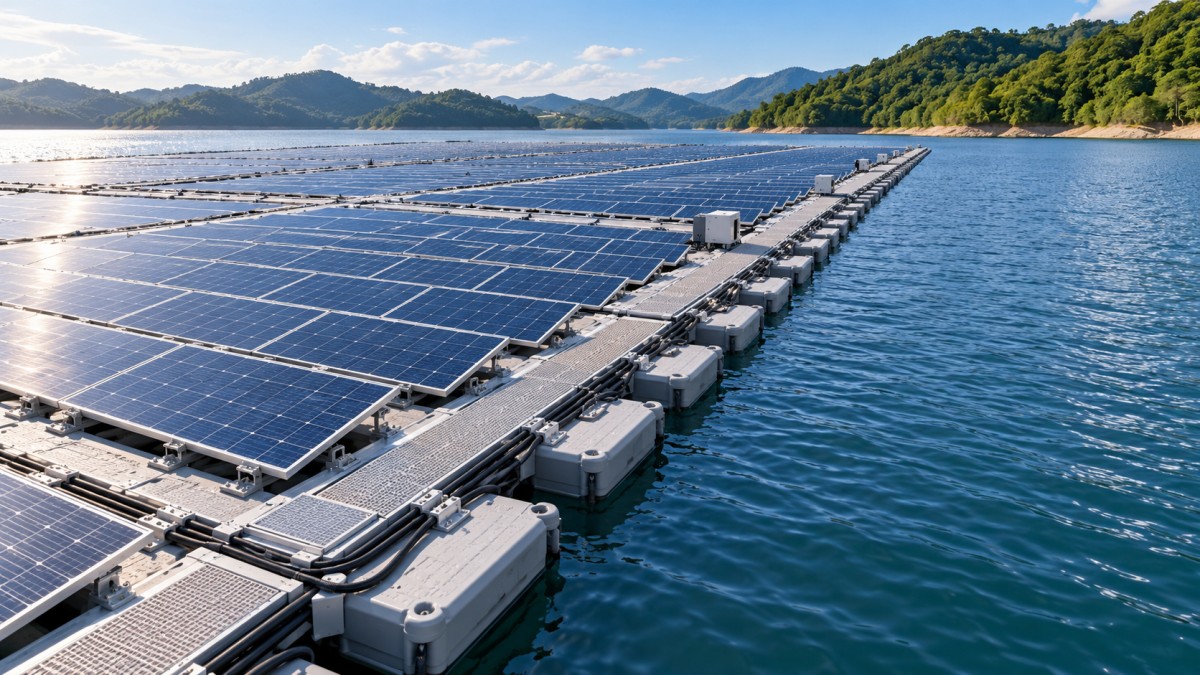
Qualification must match the site and mounting arrangement
IEC 61215 design qualification and IEC 61730 safety qualification are useful baseline checks. They are not blanket proof that a module is suitable for every floating application. Where salt exposure is relevant, IEC 61701 salt-mist testing may be part of the review, but test conditions and applicability still need examination.
Procurement teams should verify that certificates and test reports cover the proposed model and relevant construction. Then they should compare permitted mounting zones, clamp requirements, and mechanical loading assumptions with the floating-system design. A certificate attached to a product family is not a substitute for checking the configuration being purchased.
Dual-glass construction appears in established floating project references, but the label alone does not resolve durability. Edge sealing, encapsulation, junction boxes, connectors, and manufacturing consistency remain relevant. Likewise, moving to N-type TOPCon technology does not automatically establish superior floating-site reliability.
Module size can shift costs elsewhere
A larger module may reduce the number of electrical connections per installed megawatt. It may also change float dimensions, handling requirements, access arrangements, and loads on supporting components. The lowest module price per watt can therefore produce a less attractive installed system.
Bifacial gain deserves similar discipline. Rear-side irradiance depends on platform coverage, module clearance, tilt, water conditions, and shading. Reflective water in a promotional image is not an energy-yield calculation. Any assumed gain should be supported by a site-specific model and credible sensitivity analysis.
Bankability and delivery can decide the award
A technically acceptable module still needs an acceptable commercial counterparty. Lenders and owners may examine financial resilience, warranty enforceability, manufacturing traceability, and the practical route for resolving claims. A long performance warranty has limited value if the responsible entity is unclear or the installation falls outside permitted use.
For floating projects, written confirmation of warranty applicability is especially useful. Buyers should ask whether the proposed water environment and mounting arrangement are covered, what installation conditions apply, and who bears removal, transport, testing, and reinstallation costs after an accepted claim. Those costs can be material when replacement requires specialized access.
Delivery capability is equally project-specific. Reservoir access, seasonal water levels, environmental restrictions, and grid-connection milestones may constrain installation. A missed shipment can affect more than the construction schedule if it pushes work beyond an available access window.
A credible offer should therefore identify the production location, shipment sequence, inspection arrangements, and substitution controls. “Equivalent module” provisions deserve attention: a different size, weight, connector, or electrical characteristic may require engineering approval even when nominal wattage is unchanged.
How to read the market without inventing a league table
The available project evidence points toward competition among established utility-scale suppliers rather than a completely separate class of floating-only module manufacturers. However, selection remains local. Domestic-content requirements, import rules, approved supplier lists, financing conditions, and service arrangements can narrow a tender before technical scoring begins.
Another distinction is between repeatable reservoir development and more demanding nearshore or offshore concepts. A supplier with strong inland references should not automatically receive the same assessment for wave-exposed marine deployment. Evidence should become more demanding as the operating environment departs from previous installations.
Module technology transitions also complicate comparisons. A successful project commissioned several years ago may use a different cell technology, module format, or bill of materials from today’s offer. The reference demonstrates organizational experience; it does not validate every subsequent product.
This is where G-REI’s cross-disciplinary approach is useful. Module benchmarking should connect with floating-structure engineering, grid-access requirements, project economics, and any storage or power-control architecture. The award is commercially meaningful only if the supplied equipment fits the asset that will actually be built.
Build a shortlist around evidence, not headline frequency
Start with suppliers that can substantiate comparable deployments, including names such as Trina Solar, LONGi, and JA Solar where their references match the project context. Then request an evidence package tied to the proposed module: applicable certificates, mounting approval, environmental suitability, warranty terms, manufacturing source, and a realistic delivery schedule.
Keep award tracking separate from technical qualification. Record the announcement date, original source, contracting entity, capacity basis, supply scope, and latest verified milestone. That creates a usable market view without presenting incomplete disclosures as market share.
The supplier worth advancing is not necessarily the one with the newest headline or highest wattage. It is the one whose project evidence, proposed product, contractual responsibilities, and delivery plan remain consistent when checked against the site’s actual operating conditions.
Deep Dive
Related Intelligence
- Can a renewable energy planning platform estimate solar yield?Author :

- How to verify a solar water pumping system exporter's flow ratingsAuthor :

- Which module suppliers are winning floating solar project contracts?Author :

- What certifications should a CdTe thin-film solar panel OEM provide?Author :