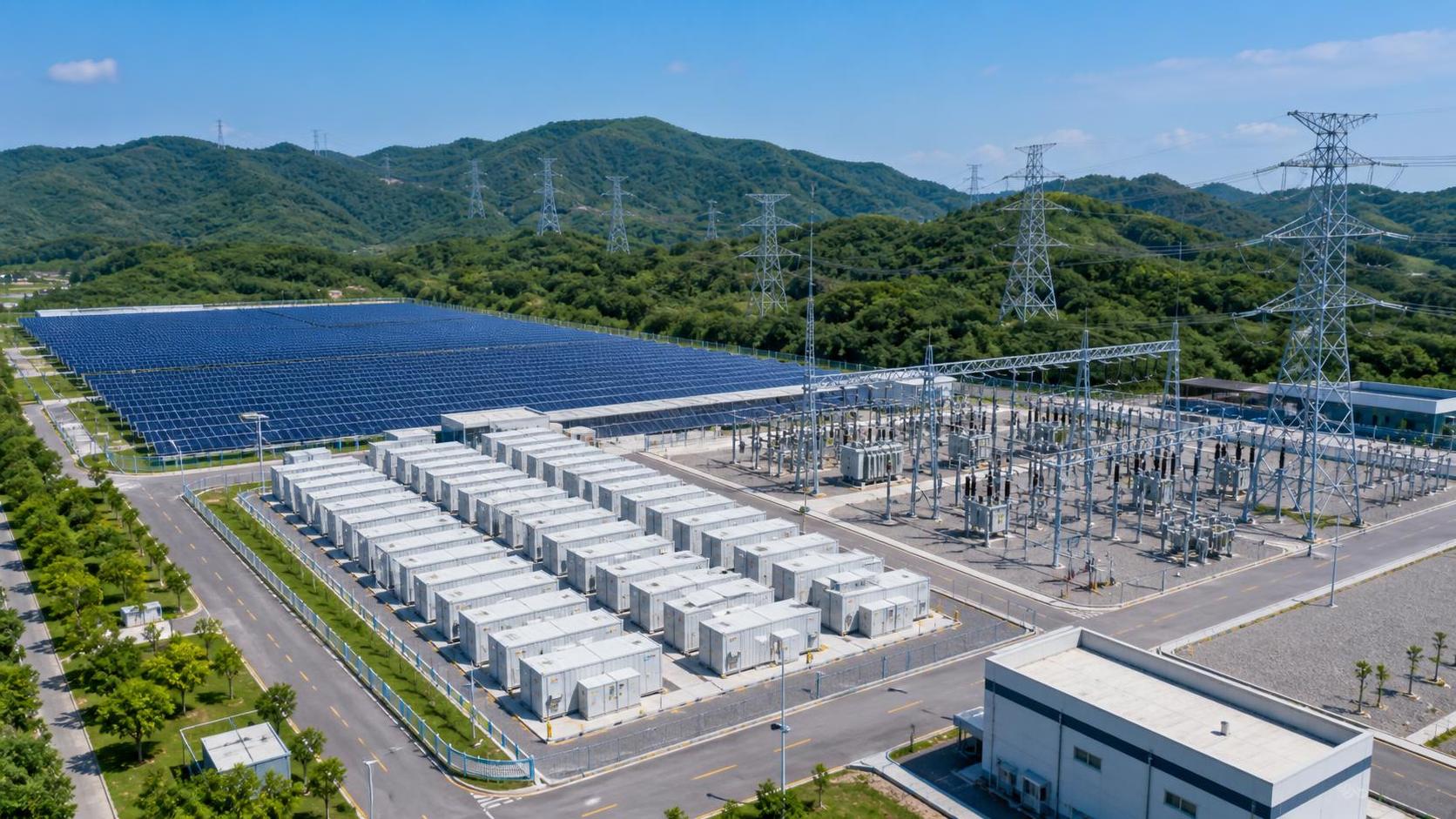
Solar Cable OEM Supplier: Key Safety and Compliance Checks
Key Takeaways
- How grid access delays are reshaping renewable project timelines in Latin AmericaDr. Elena Volt
- What drives energy storage systems price per kWh for commercial projects?Dr. Julian Volt
- What manufacturers should compare in emissions tracking softwareLina Cloud
- Why high-net-worth buyers are reshaping demand for automotive technologyDr. Aris Sun
- Can project tender intelligence software improve bid opportunity quality?Lina Cloud
- Which metrics reveal whether a P2P energy trading platform is working?Lina Cloud
- When does strategic link acquisition improve a clean energy site's authority?Dr. Aris Sun
- What drives solar street lighting cost for a new installation?Dr. Aris Sun
Industry Overview
Our mission is to safeguard the future of global renewable energy development through verifiable data, interdisciplinary academic scrutiny, and unwavering industry integrity.
Choosing a reliable solar cable OEM supplier is not just a sourcing decision—it is a frontline safety and compliance priority. For quality control and safety managers overseeing renewable energy projects, every cable must meet strict standards for fire resistance, insulation integrity, durability, and certification traceability. This guide outlines the key checks that help reduce operational risk, prevent non-compliance, and protect long-term system performance.
Why does a solar cable OEM supplier matter so much in risk-controlled energy projects?
In utility-scale PV, commercial rooftops, storage-linked solar systems, and smart-grid infrastructure, cable failure rarely stays a minor component issue. It can escalate into hot spots, insulation breakdown, arc faults, downtime, warranty disputes, and delayed grid acceptance.
For quality control teams, the challenge is not simply buying cable that looks compliant on paper. The real task is verifying whether a solar cable OEM supplier can consistently manufacture products that match declared standards across batches, environments, and delivery cycles.
This is especially relevant in the broader renewable and smart-grid sector, where project owners must align hardware reliability with IEC, UL, and local code expectations. G-REI’s benchmarking approach is useful here because it connects component-level verification with project-level compliance risk.
- A weak supplier can pass a sample inspection yet fail in mass production consistency.
- Incomplete documentation can delay customs clearance, EPC approval, or final commissioning.
- Poor material control may create hidden failures after UV exposure, thermal cycling, or humidity stress.
What should QC and safety managers check first before approving a supplier?
A practical prequalification review should begin with manufacturing traceability, standards alignment, and process control. Before comparing price, lead time, or packaging, teams should confirm whether the solar cable OEM supplier has a repeatable compliance system rather than a sales-only response.
The table below can be used as an initial supplier screening framework for renewable energy procurement, factory audits, and incoming quality approval.
For QC teams, this screening step helps separate genuine manufacturing capability from simple trading activity. A strong solar cable OEM supplier should respond with structured data, not vague assurances or generic PDFs.
Core pre-audit questions
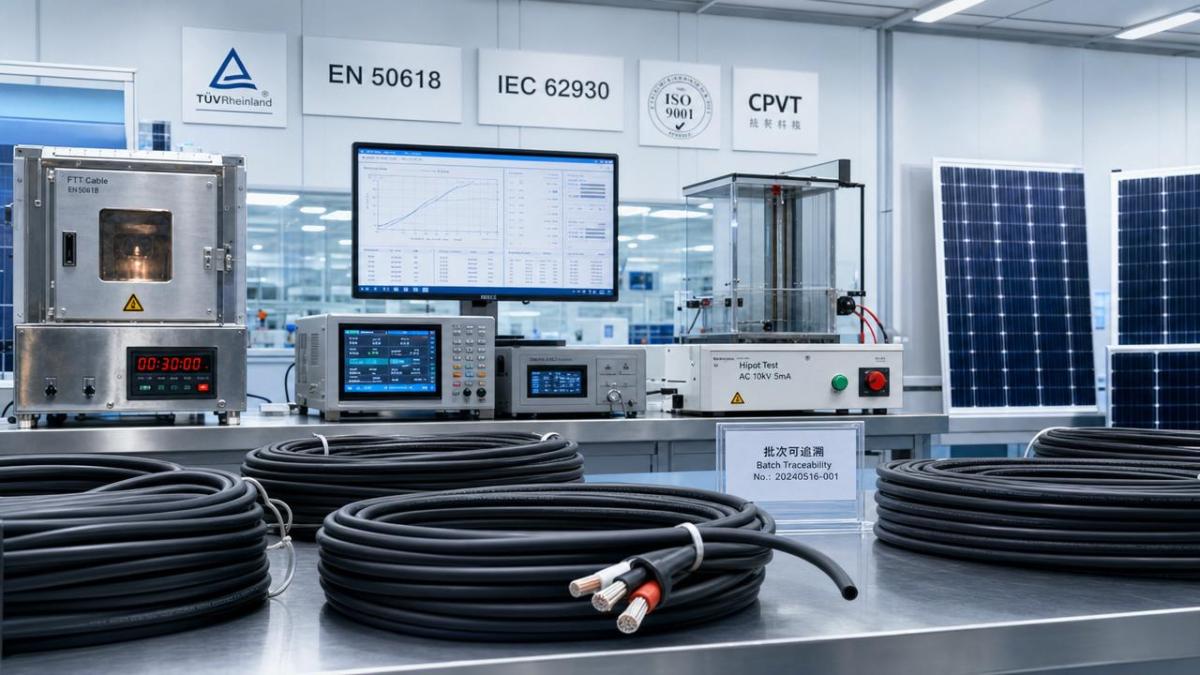
- Can the supplier map each shipment to production date, raw material lot, and test report?
- Are routine tests performed on every production batch or only on selected orders?
- Do the cable markings match the certification scope and technical datasheet?
- Can the supplier provide aging, flame, and weathering evidence relevant to project conditions?
Which safety and compliance checks are non-negotiable?
Not every project uses the same installation method, but some checks apply almost everywhere. Solar cable is exposed to UV radiation, outdoor heat, moisture, mechanical stress, and DC operating conditions for years. That makes compliance a functional requirement, not a paperwork exercise.
1. Conductor quality and electrical consistency
Verify conductor material, nominal cross-section, resistance values, and strand consistency. Undersized conductor area or poor stranding can increase resistive heating, reduce system efficiency, and raise fire risk in tightly packed cable runs.
2. Insulation and sheath integrity
Check insulation thickness uniformity, sheath adhesion, elongation performance, and resistance to cracking. In PV applications, insulation failure can lead to leakage current, moisture ingress, and premature aging under temperature cycling.
3. Flame performance and smoke considerations
Projects near buildings, tunnels, substations, or enclosed service areas may require stricter fire behavior review. Safety managers should not assume all solar cables offer the same flame retardancy or smoke characteristics.
4. UV, ozone, and weather resistance
Outdoor installations demand long-term resistance to sunlight, ozone, humidity, and harsh temperature variation. A capable solar cable OEM supplier should explain how compound selection and validation testing support these conditions.
5. Certification scope and document accuracy
The certificate itself is not enough. QC teams must confirm that conductor size range, voltage rating, temperature class, and product construction in the purchase order actually fall within the certificate scope.
How do leading teams compare one solar cable OEM supplier with another?
A side-by-side comparison works better than isolated claims. For procurement decisions in complex renewable portfolios, teams should compare compliance depth, process transparency, engineering support, and supply execution together.
The comparison table below helps procurement, HSE, and QA teams score a solar cable OEM supplier beyond unit price.
This comparison matters because low-cost offers often hide weak documentation discipline or unstable material sourcing. In energy projects, the cost of a cable recall, field replacement, or commissioning delay can exceed the initial savings quickly.
What technical data should be reviewed before final approval?
A solar cable OEM supplier should provide more than a nominal size and voltage statement. QC and safety managers should request a technical review set that supports both installation safety and lifecycle performance.
Minimum technical review points
- Rated voltage and whether it matches DC PV system design requirements.
- Conductor material and resistance data under the applicable standard.
- Operating temperature range and short-term overload tolerance.
- Minimum bending radius for rooftop, tracker, or confined routing conditions.
- UV, ozone, water, and abrasion resistance claims backed by relevant testing.
- Compatibility with connectors, terminations, and installation practices used on site.
If projects integrate solar generation with BESS, smart distribution, or digital monitoring infrastructure, cable selection should also consider routing density, thermal accumulation, and fire zone separation. G-REI’s cross-sector perspective is valuable because these interfaces are increasingly common in modern energy assets.
Which documents reduce audit findings and commissioning delays?
Many non-conformities appear not because the cable itself is defective, but because the supporting documentation is incomplete, inconsistent, or issued too late. For a quality-controlled procurement process, document readiness is part of supplier quality.
The document checklist below is useful when evaluating a solar cable OEM supplier for EPC tenders, owner approval, or third-party inspection preparation.
When documentation is aligned early, project teams spend less time reconciling mismatched specs, chasing missing files, or explaining deviations to owners and inspectors. That is a direct risk reduction benefit, not just an administrative improvement.
Common mistakes when selecting a solar cable OEM supplier
Even experienced teams sometimes approve suppliers too quickly under schedule pressure. The most common mistakes are predictable and avoidable if QC, HSE, and procurement align their evaluation criteria from the start.
- Accepting a certificate without checking whether the ordered cable construction is actually covered.
- Comparing only price per meter while ignoring failure cost, replacement labor, and schedule impact.
- Skipping sample verification of print marking, jacket quality, and packing traceability.
- Treating rooftop, desert, coastal, and storage-adjacent installations as if they impose the same cable stress.
- Assuming OEM status automatically means strong factory controls without audit evidence.
These mistakes become more serious in multinational projects, where local grid-access rules, insurer expectations, and owner technical specifications may differ. A disciplined solar cable OEM supplier should help clarify these gaps before delivery, not after a site issue appears.
FAQ: practical questions from QC and safety teams
How do I verify whether a solar cable OEM supplier is truly manufacturing the product?
Ask for a production flow explanation, routine test sequence, traceability format, and sample lot documentation. A genuine manufacturer can usually explain conductor input control, extrusion checkpoints, spark testing, final inspection, and packaging release logic with consistency.
Which projects need stricter compliance review?
Projects in high-temperature regions, coastal zones, industrial rooftops, storage-integrated sites, public buildings, and export markets often need deeper review. These environments raise the importance of weather resistance, fire behavior, documentation completeness, and compatibility with local approval practice.
What should incoming inspection focus on after delivery?
Check reel labeling, cable marking continuity, visible sheath defects, dimensional consistency, shipment quantity, and correspondence between the batch and the test report. If the project is sensitive, retain sample segments for verification and future trace analysis.
Is the lowest-priced solar cable OEM supplier ever the right choice?
Sometimes, but only when documentation quality, testing discipline, and material stability are also demonstrated. The right decision is total risk-adjusted value, not headline price. In renewable infrastructure, hidden quality gaps often appear after installation, when correction is most expensive.
Why choose us for solar cable supplier benchmarking and sourcing support?
G-REI supports quality-driven procurement by connecting component evaluation with wider renewable and smart-grid project realities. That means solar cable assessment is not treated in isolation. It is reviewed against system reliability, grid-access expectations, documentation readiness, and long-term asset performance.
Our value for QC and safety managers lies in structured decision support. We help teams compare supplier claims against internationally recognized standards, practical installation risk, and cross-sector energy infrastructure requirements.
- Parameter confirmation for conductor size, voltage rating, insulation structure, and environmental suitability.
- Supplier screening support for certification scope, batch traceability, and factory document readiness.
- Selection guidance for utility-scale PV, rooftop solar, storage-coupled systems, and smart-grid linked installations.
- Discussions on lead time, sample support, labeling requirements, compliance review points, and quotation alignment.
If your team is evaluating a solar cable OEM supplier, planning a new tender, or trying to reduce supplier approval risk, contact us with your target standards, operating environment, required cable sizes, documentation expectations, and delivery schedule. We can help you refine selection criteria, compare options, and prepare a more audit-ready procurement path.
Deep Dive
Related Intelligence
- How grid access delays are reshaping renewable project timelines in Latin AmericaAuthor :

- How renewable development for utilities can improve grid resilienceAuthor :

- When does smart grid software with real-time analytics improve outage response?Author :

- How to Evaluate Industrial Technology Sourcing Suppliers for Delivery RiskAuthor :