How black-start capability strengthens resilient energy infrastructure
Key Takeaways
- Australian Energy Minister Seeks Mandatory Energy Contracts for Data CentresDr. Elena Volt
- Can a renewable energy planning platform estimate solar yield?Dr. Aris Sun
- Portugal Mandates Grid-Forming Capability for Large Storage, Launches 1 GW TenderDr. Elena Volt
- Can distributed energy systems keep commercial buildings powered during outages?Dr. Elena Volt
- China Sets Wind Power Capacity Credit Target of Around 11% by 2030Marcus Wind
- How to verify a solar water pumping system exporter's flow ratingsDr. Aris Sun
- IRENA Warns Global Clean Energy Additions Could Fall in 2026 as Grid Constraints BiteDr. Elena Volt
- What tests should a three-phase hybrid solar inverter factory run?Dr. Aris Sun
Industry Overview
Our mission is to safeguard the future of global renewable energy development through verifiable data, interdisciplinary academic scrutiny, and unwavering industry integrity.
Black-start capability strengthens resilient energy infrastructure when an asset can establish a stable electrical supply from a de-energized state, energize a defined restoration path, and sustain the recovery of connected loads. A credible specification must identify the starting conditions, available energy, network configuration, and acceptable voltage and frequency behavior. Rated generation capacity or a grid-forming control mode alone does not demonstrate that the complete installation can perform this sequence.
The decisive boundary is the point at which external support becomes unavailable. An installation that needs an energized feeder to power its controls, close its breakers, or establish its DC supply has an unresolved dependency. Reliable restoration requires an independently supported chain from auxiliary power through initial energization to sustained operation.
The restart chain begins before AC voltage appears
Black-start readiness starts with equipment that often sits outside the headline power rating: control power supplies, protection relays, battery management systems, communications equipment, breaker mechanisms, and necessary cooling or ventilation. These functions must remain available through the assumed blackout duration or recover from an independently supplied source. Otherwise, the main converter or generator can be technically capable of starting while the installation remains unable to execute the sequence.
For battery energy storage, usable DC energy does not automatically establish restart readiness. The battery management system must permit discharge, contactors must operate, the DC link must reach its required condition, and the power conversion system must initialize without an external AC reference. Temperature limits, low state of charge, isolation faults, and auxiliary supply depletion can each prevent startup before power reaches the network.
A restoration specification therefore needs a defined initial state. That state should include the expected outage duration, battery reserve, ambient conditions, equipment availability, and the status of local control and communications. Testing immediately after an orderly shutdown proves a different capability from restarting after an extended loss of site power.
Black start also differs from seamless islanding. Seamless islanding preserves an already energized local system after separation from the wider grid. Black start establishes voltage on a dead system. Successful islanding tests provide useful evidence about load balance and controls, but they do not demonstrate dead-bus energization or recovery of auxiliaries.
Grid-forming control must work across the restoration envelope
A grid-forming inverter establishes an internal voltage reference and supports frequency within its operating limits. This makes it a potential source for an electrical island. A grid-following inverter ordinarily requires an existing voltage waveform for synchronization and current injection; it cannot be assumed to establish the first energized bus.
However, grid-forming behavior during normal operation does not prove black-start capability. Starting into a dead bus introduces different control states, transformer magnetization, network charging, and load pickup events. The converter must transition through these conditions without losing its voltage reference, entering an unstable current-limiting mode, or tripping on protection intended for another operating state.
Current limiting is a central constraint. During a disturbance, the inverter has to protect its semiconductor devices while supporting the island. The way it prioritizes active and reactive current determines what happens next. Restricting active current can impair frequency recovery; restricting reactive current can weaken voltage support. A declared overload rating is incomplete without its duration, triggering conditions, and recovery behavior.
When several grid-forming sources operate together, stable sharing requires coordinated controls. Droop characteristics, virtual impedance, measurement filters, and power limits affect circulating currents and oscillations. A controller proven against a strong grid still needs evidence for operation in the small, electrically weak island expected during restoration.
Energizing the network can be harder than supplying its load
The first restoration stage frequently connects equipment with little useful active-power demand but significant transient or reactive requirements. Transformer inrush depends on residual core flux, switching instant, transformer characteristics, and the applied voltage waveform. An inverter with sufficient steady-state capacity can still reach its current limit during this event, causing voltage collapse or a protective trip.
Controlled voltage ramping, suitable switching sequences, or transformer-specific energization measures can reduce the burden. Their effectiveness must be demonstrated with the actual transformer and network arrangement represented. A successful test using a small laboratory transformer does not establish performance for a long restoration feeder containing several transformers.
Long cables and lightly loaded lines introduce another challenge: capacitive charging. The restoration source may need to absorb reactive power while controlling bus voltage. A capability statement that highlights reactive-power injection but omits absorption leaves this operating condition unresolved. Shunt compensation and its switching sequence also influence whether the initial island remains within voltage limits.
The restoration path should therefore be represented as successive electrical states: auxiliary supply established, source bus energized, transformer connected, feeder energized, and selected load blocks restored. Each transition changes the impedance and power balance seen by the source. The relevant design question is whether every transition remains inside its controllable operating envelope.
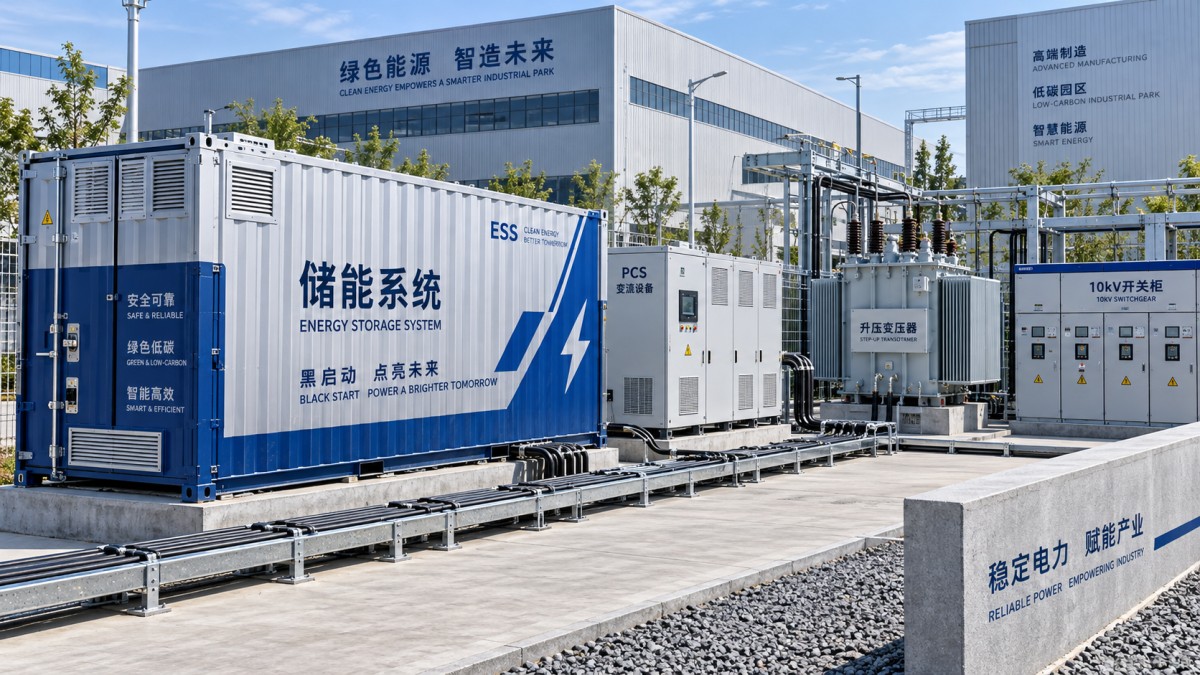
Power capability and energy reserve answer different questions
Power capability determines whether the source can withstand the next switching event or load step. Energy reserve determines how long it can support restoration while waiting for additional generation or network reconnection. Both limits matter, but they require separate calculations.
A useful energy budget adds the energy needed by auxiliaries and restored loads over the expected restoration period, then accounts for conversion losses, reserve requirements, and unavailable battery capacity. Usable capacity must reflect the permitted state-of-charge window, temperature, degradation, and discharge constraints. The nameplate energy rating is insufficient when these restrictions materially reduce the available reserve.
Motor starting and cold-load pickup complicate the power calculation. Motors demand starting current and reactive support; stalled motors can prolong that demand. After an outage, thermostatically controlled loads can reconnect together because their normal diversity has disappeared. The resulting pickup requirement can exceed the pre-outage feeder demand even when the same customers are being restored.
Restoration stages should be governed by measured conditions, including voltage recovery, frequency stabilization, remaining reserve, and equipment status. Fixed delays alone provide weak assurance when load behavior or generation availability changes.
Renewable output becomes useful after its dependencies are resolved
Solar PV and wind generation can extend the endurance of an energized island, but their contribution must be separated from the capability that establishes it. Grid-following renewable converters require a suitable reference and controls that permit operation in the intended island. Their reconnection thresholds, protection functions, and active-power ramps must align with the restoration sequence.
Solar availability is constrained by irradiance and the outage timing. Wind output depends on wind conditions, turbine operating limits, and the availability of required auxiliaries. Restoration plans that assume immediate renewable production without examining these conditions can leave a gap between initial energization and sustained supply.
Once renewable generation joins the island, excess production becomes a control problem. Battery charging limits, high state of charge, or slow curtailment can cause a power imbalance and frequency rise. The island needs both upward support when demand increases and a way to reduce or absorb generation when demand falls.
A remote energy-management platform can coordinate dispatch, but local voltage and frequency stability must remain dependable if communications fail. Essential startup logic and protective responses need defined behavior during lost links, delayed commands, and unavailable supervisory systems. Communication recovery must not introduce abrupt setpoint changes that destabilize an otherwise functioning island.
Protection must recognize a different fault environment
Protection designed around the fault current of a strong interconnected grid can behave differently in an inverter-supplied island. Converter fault current is constrained and shaped by its controls. An overcurrent relay that operates reliably during grid-connected service might fail to detect an islanded fault quickly enough, while settings made more sensitive can conflict with energization transients.
The analysis must include fault detection, selectivity, clearing time, and the source response during the fault. Depending on the network, differential, directional, voltage-based, or communication-assisted protection can address limitations of magnitude-only detection. Each scheme still requires validation against the available fault signals and operating topology.
Grounding also needs explicit treatment. Transformer connections, neutral grounding arrangements, and switching states determine zero-sequence paths and earth-fault behavior. A restoration configuration that removes the usual grounding source can change temporary overvoltages and relay sensitivity. Establishing the intended grounding arrangement is part of energizing the island.
Settings groups and switching interlocks must track the actual electrical state. A sequence that changes topology while leaving protection configured for grid-connected operation creates a gap between the studied system and the energized system. Failed breaker operations and incorrect status indications belong in restoration testing because they can produce precisely this mismatch.
Demonstration requires a system-level acceptance boundary
Applicable requirements come from the relevant system restoration rules, connection agreement, equipment safety requirements, and project acceptance criteria. Their scope matters: compliance with a converter interconnection standard establishes only the functions covered by that standard. It does not establish that a complete plant can restore a particular feeder or sustain its critical loads.
An acceptance specification should define the dead-system starting condition, restoration topology, load sequence, environmental limits, required duration, and allowable voltage and frequency excursions. It also needs explicit pass criteria for protection operation, unsuccessful switching, loss of communications, and interrupted startup. Without these boundaries, two demonstrations described as “black-start tests” can prove substantially different capabilities.
Electromagnetic transient studies are useful for transformer energization, converter current limiting, and fast control interactions. Longer-duration studies address dispatch, reserve depletion, and restoration timing. Models should represent the deployed controls, limits, and protection settings; a generic grid-forming model can conceal the behavior that determines whether the installation succeeds.
Controller testing with simulated equipment and power hardware testing can expose sequence errors and control interactions before site energization. Site acceptance then needs to establish the dependencies that simulation cannot confirm, including auxiliary endurance, breaker operation, wiring, sensing, and actual protection behavior. Recorded waveforms and event logs should make the cause of any deviation traceable.
The final restoration stage is reconnection to the wider network. Voltage magnitude, frequency, phase angle, breaker timing, and the transition to connected operation must remain within the agreed synchronization conditions. Changes to firmware, battery capacity, protection settings, or feeder topology can invalidate earlier evidence, so the restoration procedure and its supporting validation must remain aligned with the installed system.
Deep Dive
Related Intelligence
- Australian Energy Minister Seeks Mandatory Energy Contracts for Data CentresAuthor :

- Portugal Mandates Grid-Forming Capability for Large Storage, Launches 1 GW TenderAuthor :

- Can distributed energy systems keep commercial buildings powered during outages?Author :

- IRENA Warns Global Clean Energy Additions Could Fall in 2026 as Grid Constraints BiteAuthor :