
How BMS and EMS improve sustainable energy safety
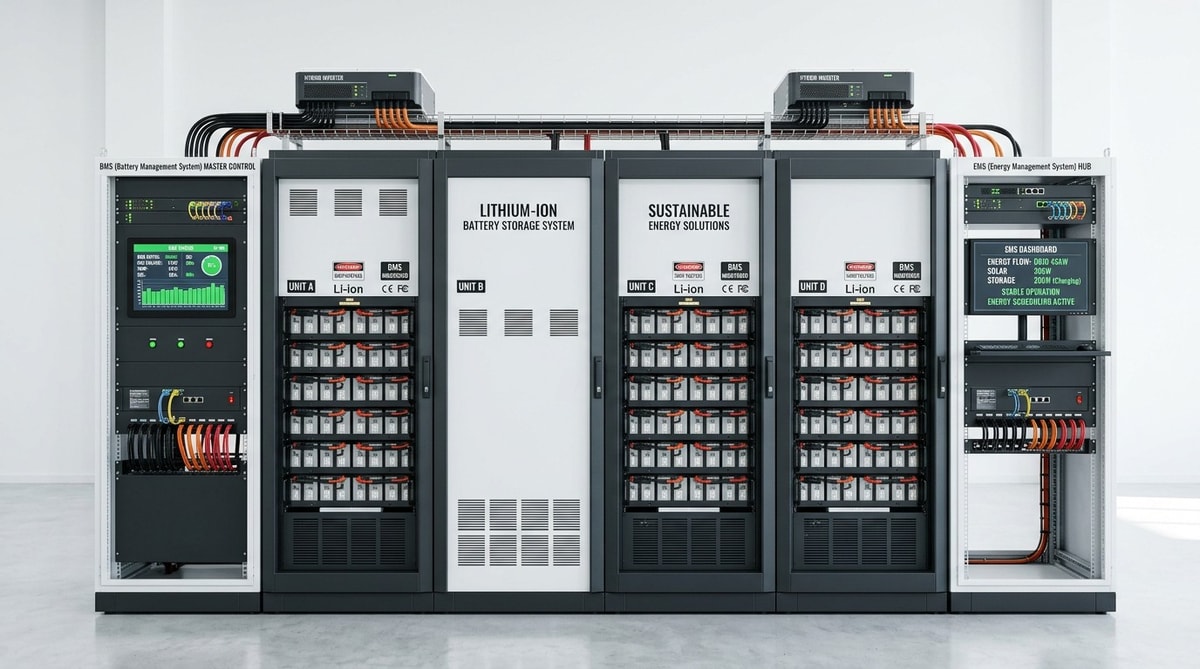
Key Takeaways
- How carbon tracking supports cleaner energy decisionsLina Cloud
- How VPP platforms reshape the energy market in 2026Lina Cloud
- What makes grid resilience a smart energy policy focus?Dr. Elena Volt
- How BMS and EMS improve sustainable energy safetyDr. Julian Volt
- Flow batteries or lithium: which energy technology lasts?Dr. Julian Volt
- Why liquid-cooled BESS matters for energy managementDr. Julian Volt
- Are N-type modules worth the cost in 2026?Dr. Aris Sun
- What affects photon yield most in clean energy projects?Dr. Aris Sun
Industry Overview
Our mission is to safeguard the future of global renewable energy development through verifiable data, interdisciplinary academic scrutiny, and unwavering industry integrity.
As sustainable energy systems scale across utilities, industry, and smart grids, safety has become central to Energy Innovation and long-term performance. BMS and EMS work together to strengthen Energy Management, improve Energy Efficiency, and support Clean Energy operations by reducing battery risks, optimizing power flow, and enabling smarter control. For organizations navigating a fast-changing Energy Market and stricter Energy Policy, understanding this synergy is essential to building resilient Energy Infrastructure and reliable Energy Solutions.
For most buyers, operators, and project teams, the key question is not whether battery management matters, but how Battery Management Systems (BMS) and Energy Management Systems (EMS) work together to reduce real-world safety risks while improving system value. The short answer is this: BMS protects the battery at the cell, module, and rack level, while EMS makes higher-level decisions about charging, discharging, load coordination, and grid interaction. When these systems are properly integrated, they help prevent thermal runaway, avoid damaging operating conditions, improve asset life, and support safer, more stable renewable energy operations.
Why BMS and EMS matter more as sustainable energy systems scale
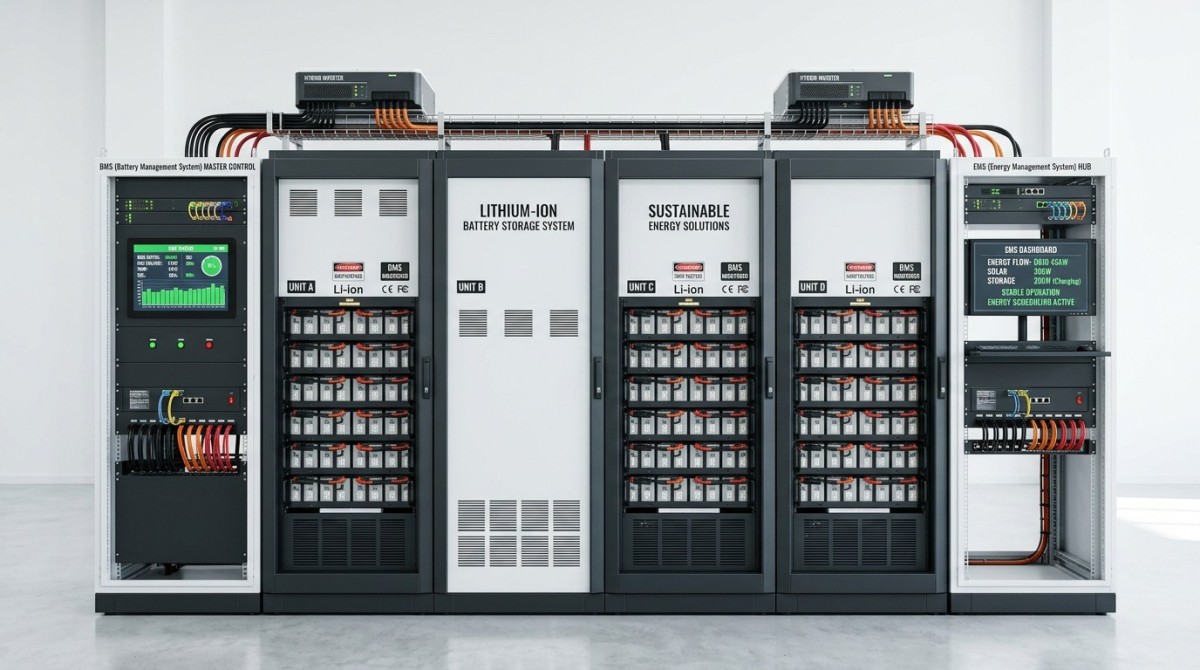
In small or simple energy setups, safety can often be managed with fixed operating rules and manual supervision. But in utility-scale storage, commercial microgrids, solar-plus-storage plants, EV charging hubs, and smart-grid environments, system complexity rises quickly. Renewable generation fluctuates, electricity prices move in real time, loads change unexpectedly, and batteries cycle harder. Under these conditions, safety is no longer just a hardware issue. It becomes a system-control issue.
This is where the combination of BMS and EMS becomes essential. A BMS continuously monitors battery health and safety conditions such as voltage, current, temperature, state of charge (SOC), and state of health (SOH). An EMS uses this information, along with data from inverters, meters, weather forecasts, load profiles, tariff schedules, and grid signals, to decide how the energy system should operate.
For decision-makers, the practical value is clear:
- Lower risk of battery damage and fire events
- Better use of renewable generation and stored energy
- Longer battery service life and improved total cost of ownership
- More predictable compliance with grid and safety requirements
- Improved uptime for critical energy infrastructure
For operators and safety managers, the benefit is equally important: clearer operating boundaries, earlier alarms, faster fault response, and more coordinated protection across the whole energy system.
What each system does: BMS protects the battery, EMS protects the operating strategy
A common misunderstanding is to treat BMS and EMS as interchangeable. They are not. They solve different layers of the safety problem.
BMS responsibilities typically include:
- Monitoring individual cell and pack voltages
- Tracking battery temperatures and current flow
- Estimating SOC, SOH, and sometimes state of power (SOP)
- Cell balancing to reduce inconsistency
- Detecting overcharge, overdischarge, overcurrent, insulation faults, and overheating
- Triggering protective actions such as disconnecting contactors or limiting power
EMS responsibilities typically include:
- Scheduling charge and discharge based on load, tariffs, and renewable output
- Coordinating batteries with PV, wind, diesel backup, EV charging, or grid import/export
- Maintaining reserve margins for resilience and peak shaving
- Managing dispatch logic for microgrids, virtual power plants, or demand response programs
- Applying site-level optimization rules that respect battery limits from the BMS
The safest systems are those where the EMS does not simply optimize economics in isolation. It must operate within BMS-approved limits and react immediately when battery conditions change. In other words, the BMS defines what is safe at the battery level; the EMS decides what is useful and profitable at the system level without violating those safety boundaries.
How BMS and EMS improve sustainable energy safety in practice
The real value of integration appears in day-to-day operating scenarios. Below are the main ways these systems improve safety in sustainable energy applications.
1. Preventing thermal runaway through early detection and controlled response
Battery incidents usually do not begin as dramatic failures. They often start with small abnormalities: localized heating, voltage deviation, sensor mismatch, repeated overcurrent events, or cells aging unevenly. A capable BMS detects these early signals. But detection alone is not enough. The EMS must then adjust the broader operating strategy, for example by reducing charge rates, isolating a string, shifting loads, or changing dispatch schedules.
This coordinated response reduces the chance that a localized issue develops into a severe safety event.
2. Avoiding unsafe charging and discharging decisions
In dynamic energy markets, operators may want to maximize cycling to capture arbitrage value or support peak demand events. Without proper integration, that pressure can push batteries toward aggressive operating windows. The BMS enforces hard technical limits, while the EMS ensures commercial optimization stays within safe battery conditions.
This is especially important in systems exposed to frequent cycling, high ambient temperatures, or uncertain renewable generation.
3. Managing temperature and environmental stress
Battery safety is highly sensitive to temperature. In liquid-cooled and air-cooled battery energy storage systems, thermal management performance directly affects safety outcomes. The BMS provides real-time temperature visibility; the EMS can use that data to change dispatch behavior, reduce power throughput, or prioritize cooling-related operating modes.
In practice, this means safety is not only handled by alarms after overheating occurs. It is actively managed before conditions become critical.
4. Improving fault isolation and emergency response
When faults occur, response time matters. An integrated architecture allows BMS alarms to trigger EMS-level actions such as derating, controlled shutdown, islanding, or load transfer. This can protect both the battery asset and connected electrical infrastructure.
For critical facilities, this coordination supports business continuity as well as safety.
5. Reducing long-term degradation that can become a safety issue
Battery degradation is often viewed as a performance or finance issue, but it is also a safety issue. Imbalanced cells, repeated stress at high SOC, and excessive depth of discharge can increase failure risk over time. The EMS can reduce these patterns by using battery-friendly dispatch logic informed by BMS data.
This is one of the most overlooked links between Energy Efficiency, lifecycle economics, and sustainable energy safety.
What target readers should evaluate before trusting a BMS-EMS solution
For procurement leaders, project managers, and quality or safety teams, not all solutions offer the same level of protection. The real question is how to judge whether a BMS-EMS architecture is robust enough for a specific application.
Key evaluation points include:
- Data granularity: Does the BMS provide cell-level, module-level, and rack-level visibility, or only summary values?
- Response logic: Can the EMS respond automatically to BMS alarms with predefined strategies?
- Interoperability: Do BMS, EMS, PCS, inverter, fire protection, and SCADA systems communicate reliably through standard protocols?
- Safety hierarchy: Are there clear priorities between optimization commands and protective commands?
- Alarm quality: Are alarms actionable, ranked by severity, and tied to operating procedures?
- Thermal integration: Is battery cooling or HVAC behavior reflected in dispatch strategy?
- Compliance support: Does the system align with relevant IEC, IEEE, UL, local fire codes, and grid-connection requirements?
- Cybersecurity: Can the EMS-BMS communication path be protected against unauthorized control or data manipulation?
Buyers should also ask vendors for fault case examples, event logs, and incident response logic rather than relying only on product brochures. In high-value energy infrastructure, safety claims should be verifiable.
Typical use cases where BMS and EMS integration delivers the most value
While nearly all battery-based renewable systems benefit from good controls, some applications gain especially strong safety and performance advantages.
Utility-scale solar and storage
Large PV-plus-storage sites face rapid changes in generation and dispatch targets. EMS optimization is essential, but without BMS constraints the battery can be exposed to unnecessary stress. Integration supports safer ramp control, curtailment capture, and grid services participation.
Commercial and industrial microgrids
Factories, data centers, logistics parks, and campuses need reliability as much as cost savings. Here, BMS-EMS coordination supports safe backup readiness, peak shaving, demand management, and power quality objectives.
Wind-plus-storage applications
Wind variability can create irregular charging patterns. EMS decisions based on BMS battery limits help avoid unstable or overly aggressive battery operation.
EV charging and transport energy hubs
Fast charging can place heavy stress on storage systems. Integrated control helps manage battery loading safely while balancing demand charges and site capacity constraints.
Virtual power plants and flexible distributed energy portfolios
In VPP environments, dispatch instructions can change quickly based on market signals. BMS-informed EMS control is necessary to ensure distributed battery assets are not overused or exposed to avoidable safety risk in pursuit of market participation.
Common mistakes that weaken safety even when a BMS and EMS are installed
Having both systems in place does not automatically mean the project is safe. Several common failures reduce their effectiveness.
- Poor integration between vendors: Data mapping gaps, delayed communications, or conflicting control logic can create blind spots.
- Over-prioritizing revenue optimization: Some EMS strategies push cycling intensity too far, especially in volatile energy markets.
- Insufficient commissioning: Protection logic is often not fully tested under realistic abnormal scenarios.
- Weak sensor quality or calibration: Safety decisions are only as good as the underlying measurements.
- Ignoring aging behavior: Control strategies that work well for new batteries may become unsafe as the battery degrades.
- Lack of operator training: Teams may receive alarms but not know when to derate, isolate, or shut down equipment.
For project owners, these issues highlight a key principle: sustainable energy safety depends not only on component quality, but also on system architecture, testing discipline, and operational governance.
How to approach implementation for better safety, reliability, and ROI
If your organization is planning or upgrading an energy storage or smart-grid project, the best approach is to treat BMS-EMS integration as a strategic design decision, not a software afterthought.
A practical implementation framework includes:
- Define the operating objective clearly: Peak shaving, resilience, arbitrage, renewable smoothing, grid services, or mixed use cases each require different control priorities.
- Map battery risk scenarios early: Include thermal events, sensor failure, communications loss, overcycling, and degraded-cell behavior.
- Set control authority rules: Make sure protective actions always override optimization commands.
- Specify interface requirements: Require reliable communication between BMS, EMS, PCS, SCADA, fire systems, and site controls.
- Test under abnormal conditions: Commissioning should include simulated faults, alarm escalation, and fallback operating modes.
- Train both operators and managers: Teams need to understand not only normal operation, but also alarm meaning, escalation paths, and shutdown criteria.
- Review performance continuously: Use operating data to refine dispatch logic as battery condition and site behavior evolve.
This approach helps align Energy Management goals with asset safety, project bankability, and long-term operating stability.
Final takeaway: safer sustainable energy depends on control intelligence, not just hardware quality
BMS and EMS improve sustainable energy safety because they address two different but connected risks: battery-level failure risk and system-level operating risk. The BMS protects the battery from unsafe electrical and thermal conditions. The EMS ensures the broader energy system uses the battery intelligently, efficiently, and within safe boundaries.
For information researchers, this means the value lies in the integration logic, not just the presence of two separate systems. For operators, it means better alarms, better response, and fewer unsafe operating decisions. For enterprise decision-makers, it means stronger reliability, lower incident exposure, longer asset life, and more defensible returns on Clean Energy investments.
As renewable power, storage, and smart-grid infrastructure continue to expand, organizations that treat BMS and EMS as a unified safety and Energy Innovation strategy will be better positioned to meet performance goals while protecting people, assets, and the resilience of the wider energy system.